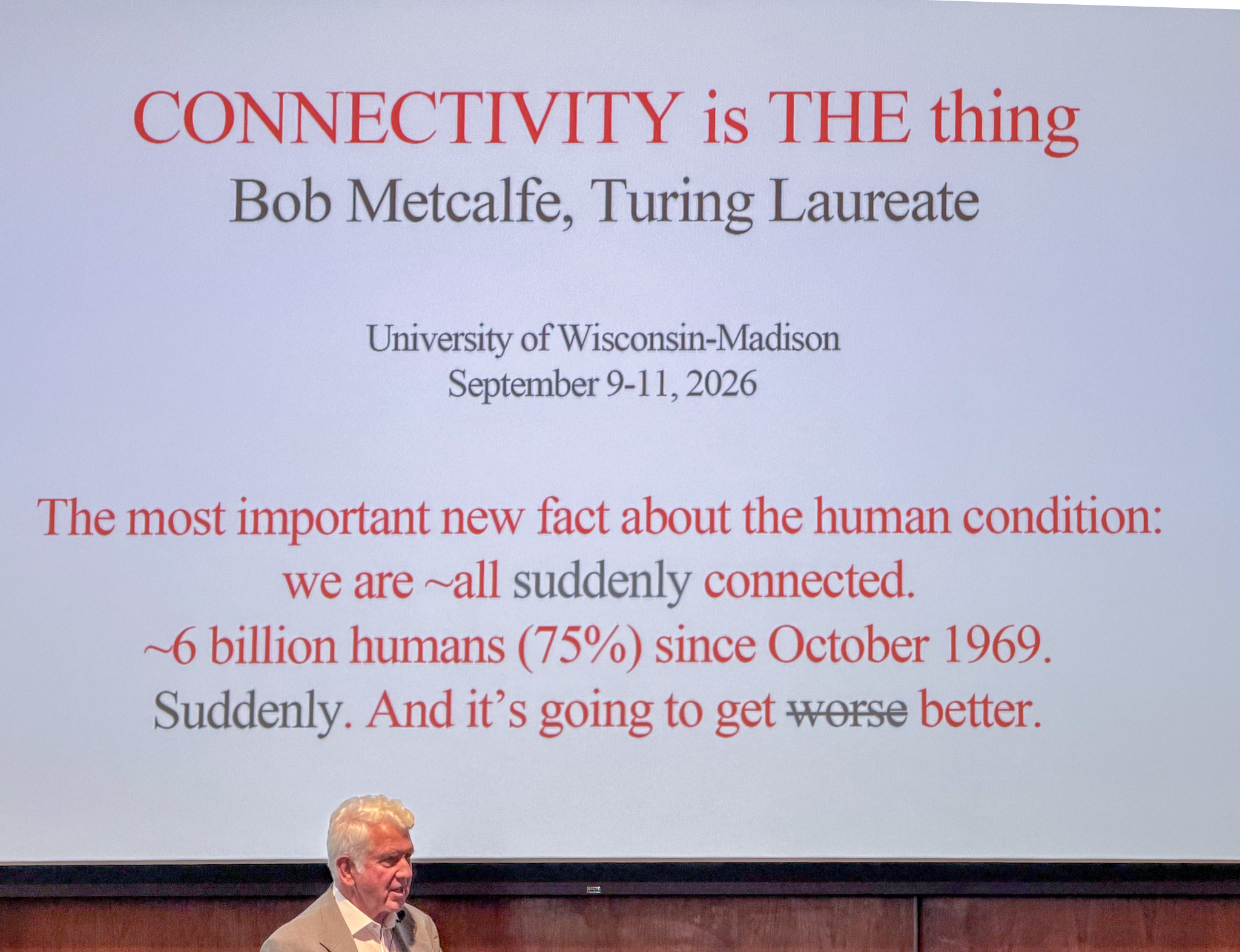
Connectivity Is the Thing
Bob Metcalfe, 2022 ACM A.M. Turing Award Laureate
Listen to the audio (MP3)[Blind] or [Grosch's] — and are never inserted silently. Passages that could not be confidently resolved are marked [unclear]. The transcript itself contains at least one unresolved internal contradiction, noted where it occurs, that this page does not attempt to silently resolve.
A Life in Connectivity
Bob Metcalfe's career traces the arc of modern networking itself — from punch cards to Ethernet to the modern internet. The timeline below places his personal milestones alongside the historic events referenced in the talk.
Introduction
Spoken by the host, not Metcalfe:
[00:00:00]"It is my great pleasure to introduce our today's distinguished lecturer, Bob Metcalfe. Bob is a true pioneer of the internet. He led the design, invention, commercialization, standardization of internet — Ethernet, which is a key technology connecting billions of computers and people together, for which he won the ACM Turing Award. Bob has founded three com [unclear — possibly “3Com” or “three companies”] and has a remarkable career spanning [00:00:30] academia, research, entrepreneurship, and venture capital."
"So today, Bob will share his perspective on more than five decades of connectivity. We are truly honored to have you, Bob, joining us. Please join me in welcoming Bob."
Metcalfe begins:
[00:01:00]"In law of the University of Wisconsin. In nineteen — In June of 1968, I married Amy June Lewis, graduate [00:01:30] of the class of '65. She's no longer with us, but — [unclear: "Diane"]. Dedicating my talk to her — and then, incidentally, are there any questions? Feel free to ask a question at any time. All I'm getting now are blank looks. Oh, there might be a question here — (are you going to this weekend's UW football game?) No. I am currently a [00:02:00] professor at the University of Texas, and so I wouldn't be allowed to attend your football game on Saturday. Who are you playing on Saturday? (I don't know)."
"See, in Texas, you ask anybody and they know who the football team is playing. Oh, that's funny."
1946 · The Transistor Year
"I was born in nineteen forty-six, July 5th."
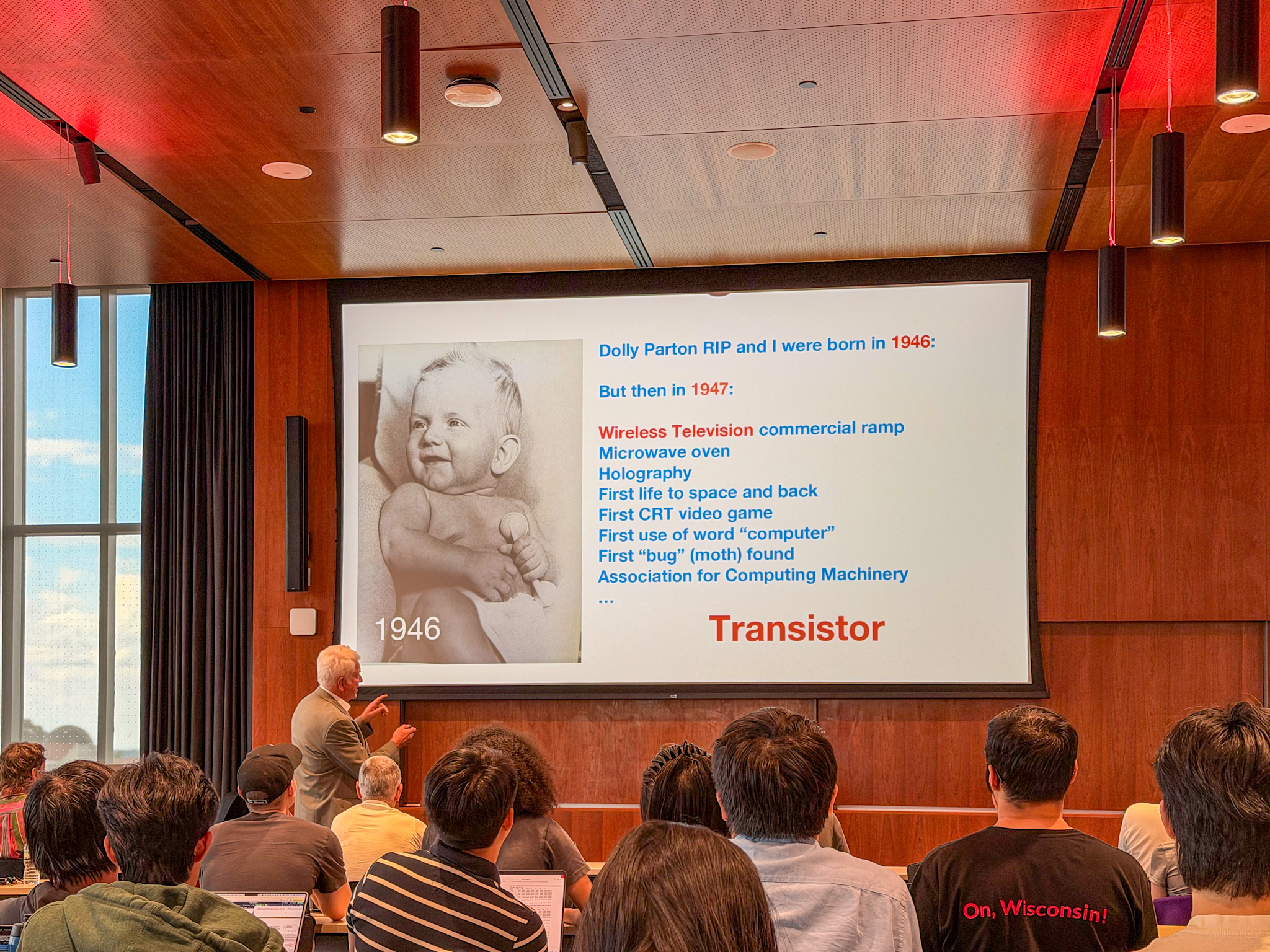
[00:02:30]"And look at all the exciting stuff that happened in nineteen forty-seven — television was wireless then — a lot of things, but the big thing that was invented in nineteen forty-six was the transistor. Do you all know that? Really was Moore's Law, the transition of getting smaller and faster forever. And this is my great [00:03:00] fortune of being born that year — I got to enjoy the years that followed based on the transistor."
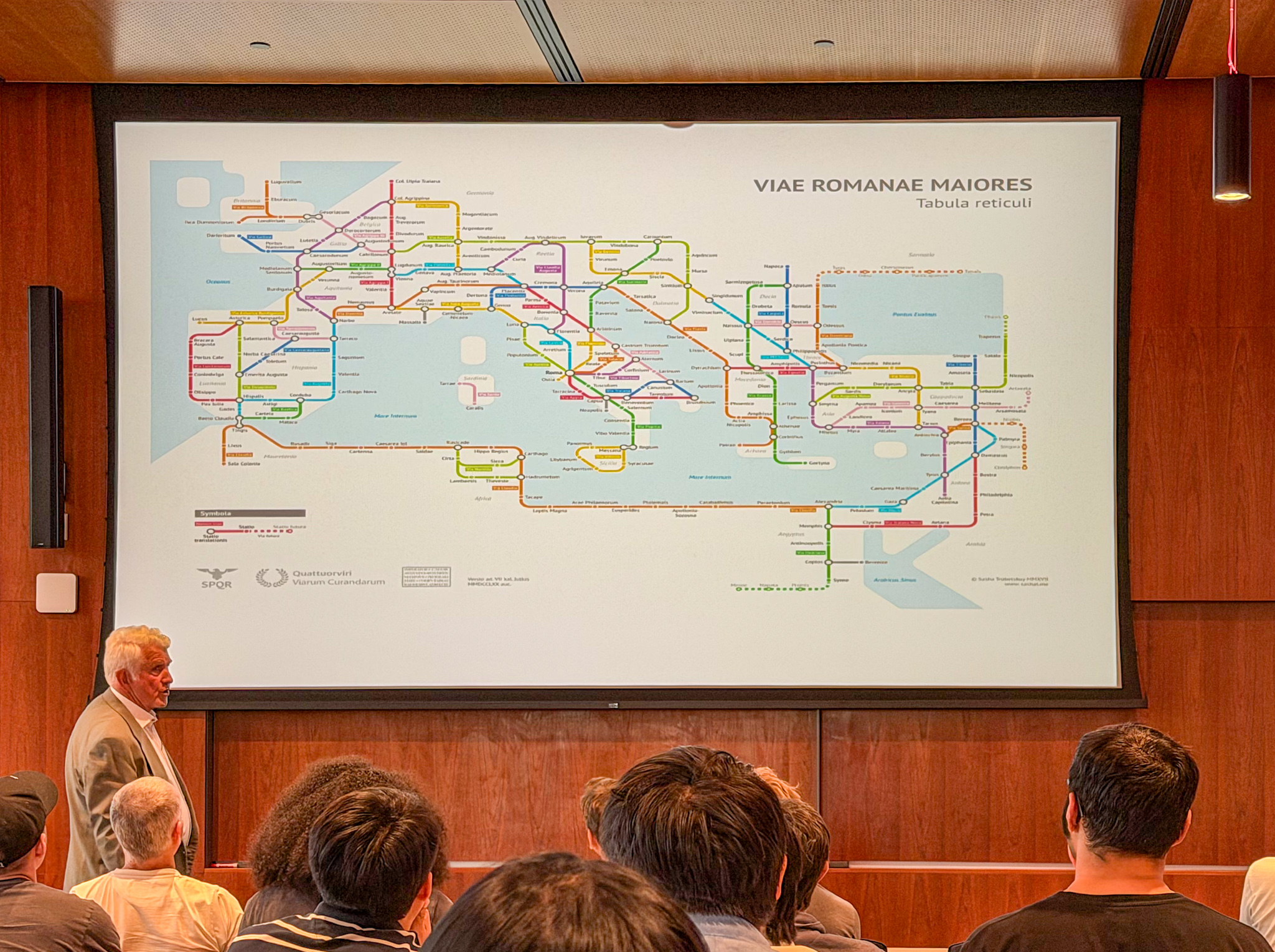
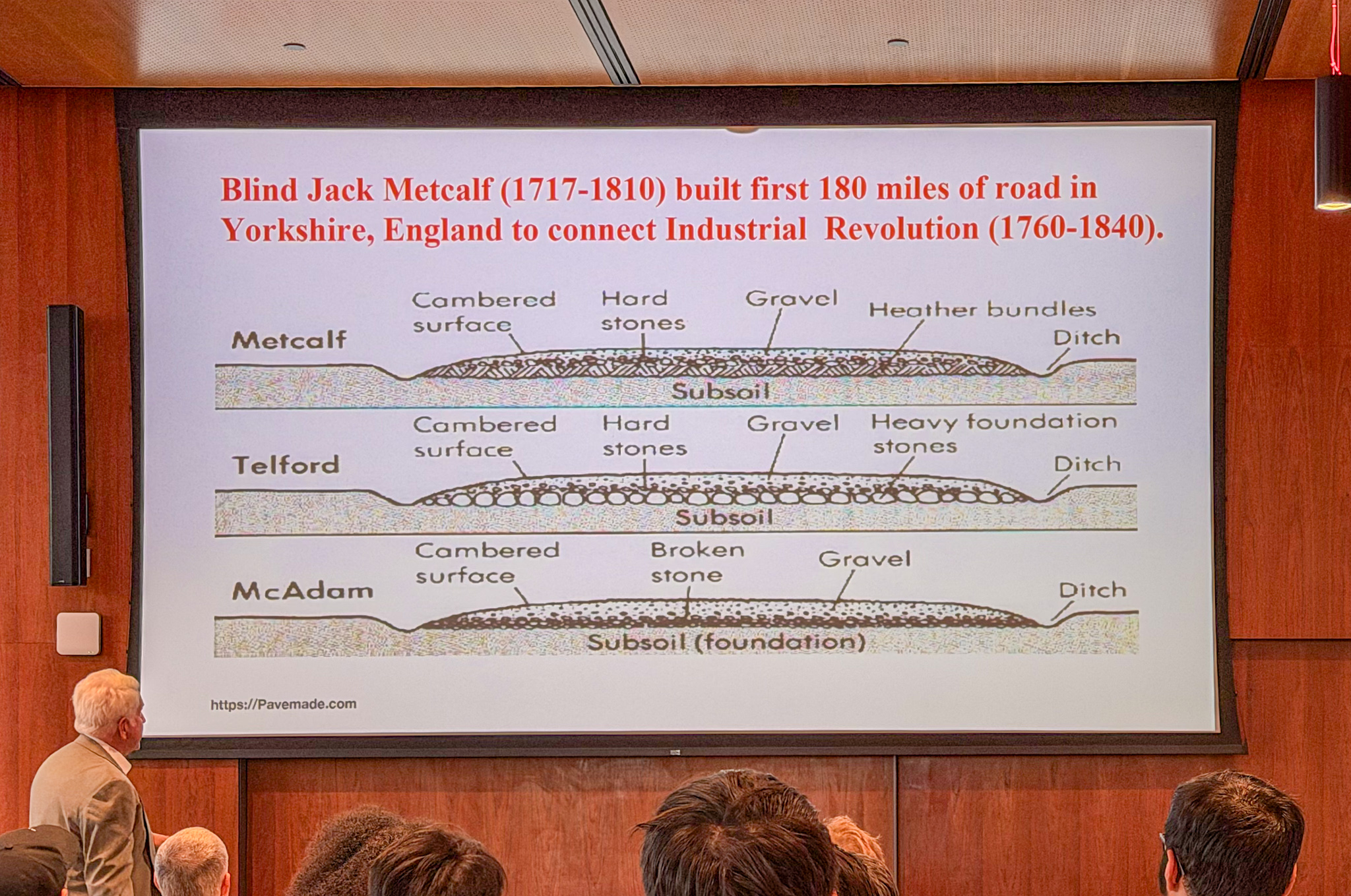
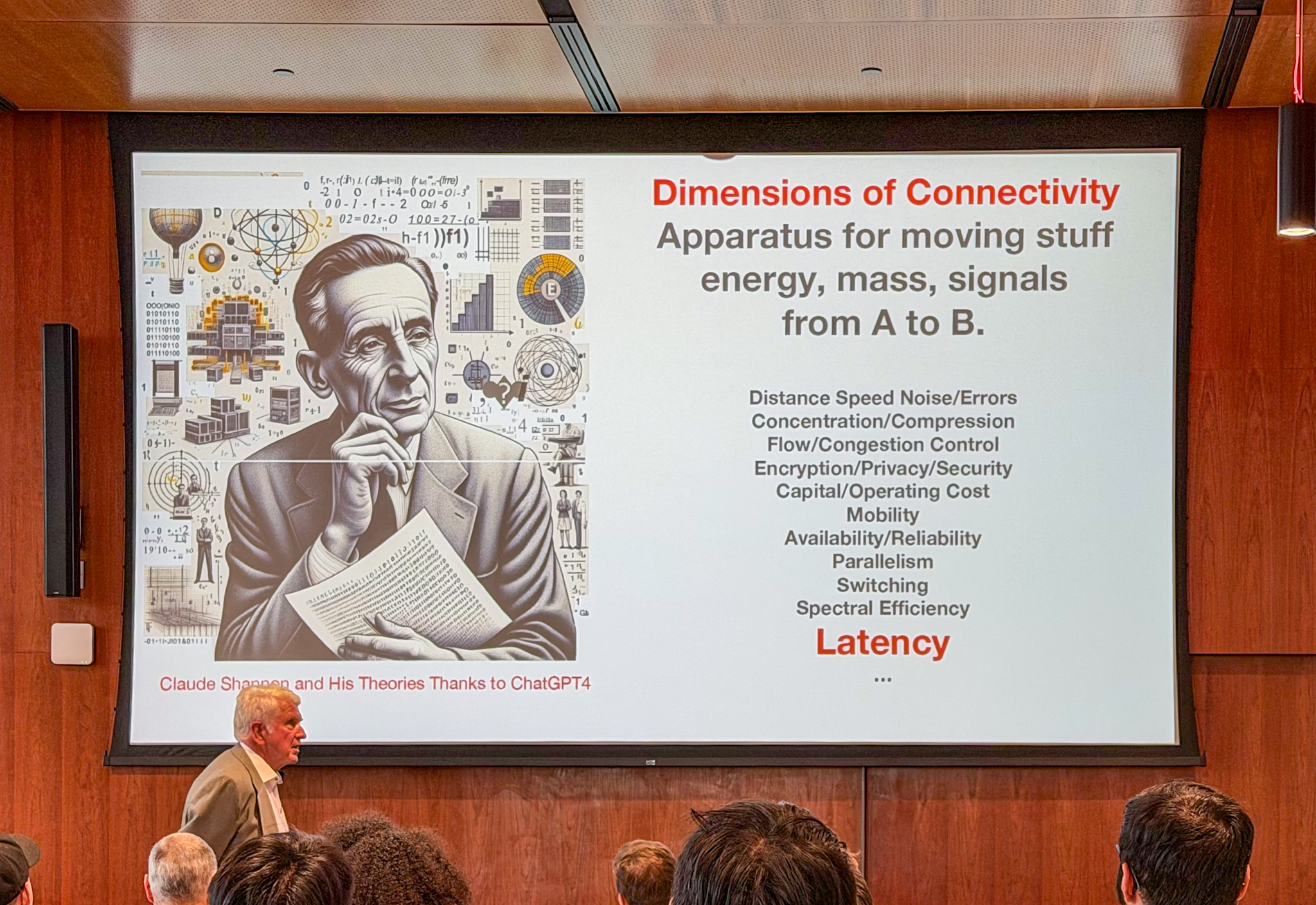
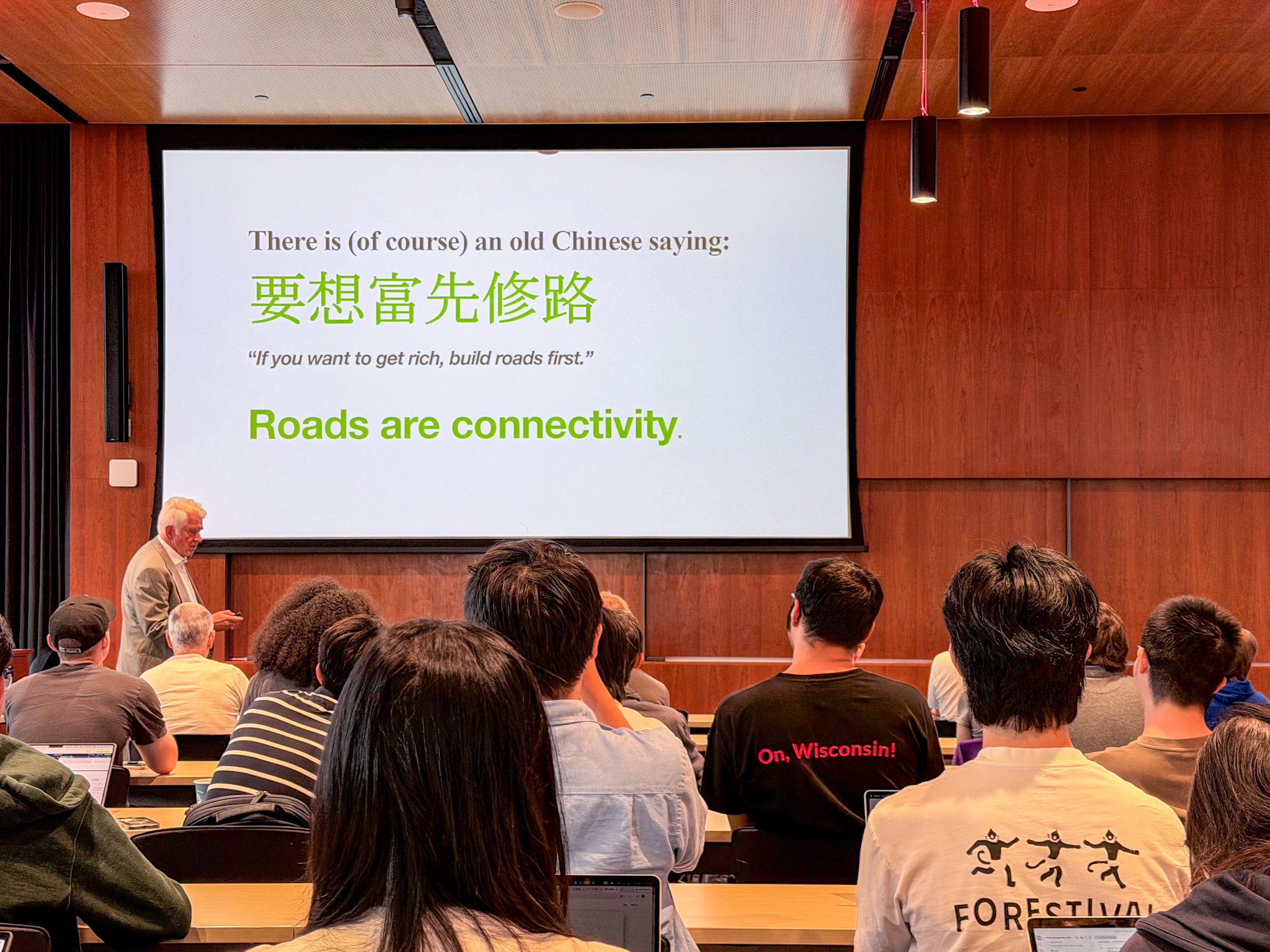
"Any questions yet? You need a Chinese saying, whatever you're talking. This is my favorite. All right — roads are connectivity. This is the Roman subway map of the Roman Empire. Yeah. And you'll notice that the Romans thought that all roads [00:03:30] led to Rome. And then there was this technology chart featuring my presumed ancestor, [transcribed as "Black John Metcalf" — likely "Blind Jack" John Metcalf, an 18th-century English road builder] John Metcalf, whose secret weapon apparently was the [unclear] "header bundle," his technology for road development. And roads are connectivity also."
[00:04:00]"But in the '60s — by the time the 1960s came, we had a telephone. And my mom would say, 'When you get there, call. Let the phone ring three times and then hang up.' I loved my mother, but not that much. And by the way, you'll notice that the telephone didn't change much. This is the Model five hundred in nineteen forty-nine. This is the Model five hundred in nineteen eighty-four. This is what happens when you turn an industry over to a monopoly. [00:04:30] It takes forever to do stuff like, for example..."
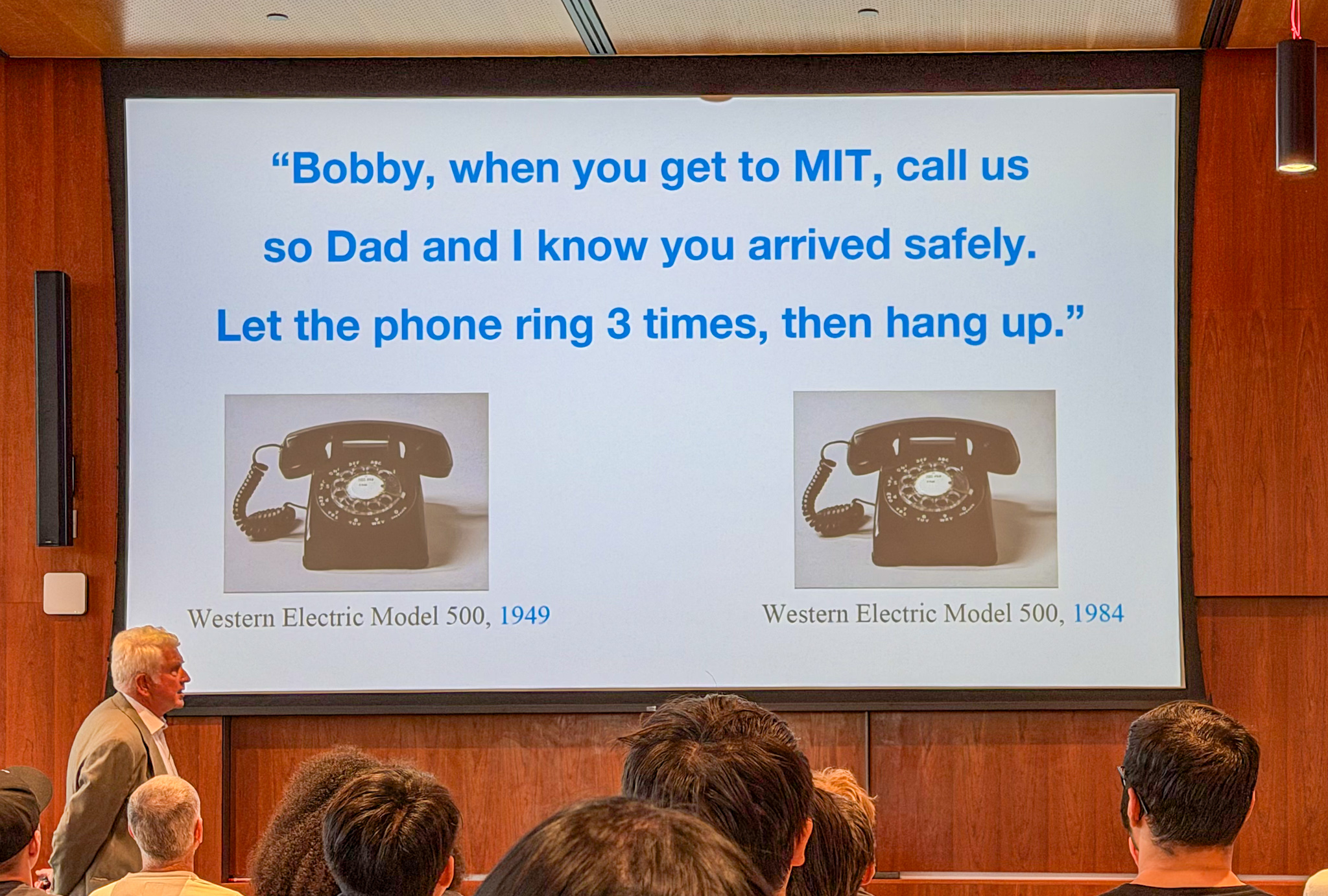
"Can you imagine Steve Jobs holding one of these up — every year?"
Connectivity, Shannon, and Punch Cards
"Connectivity is — well, it's the subject of this talk — but the so-called... What do we call him? Claude Shannon had theories about connectivity. But keep in mind, he only theorized mathematically about a very specific part of [00:05:00] connectivity. Here's a list of the other parts. Those of us working in the connectivity field, we like to increase the speed, reduce the noise, and currently the hot topic is reduce the delay."
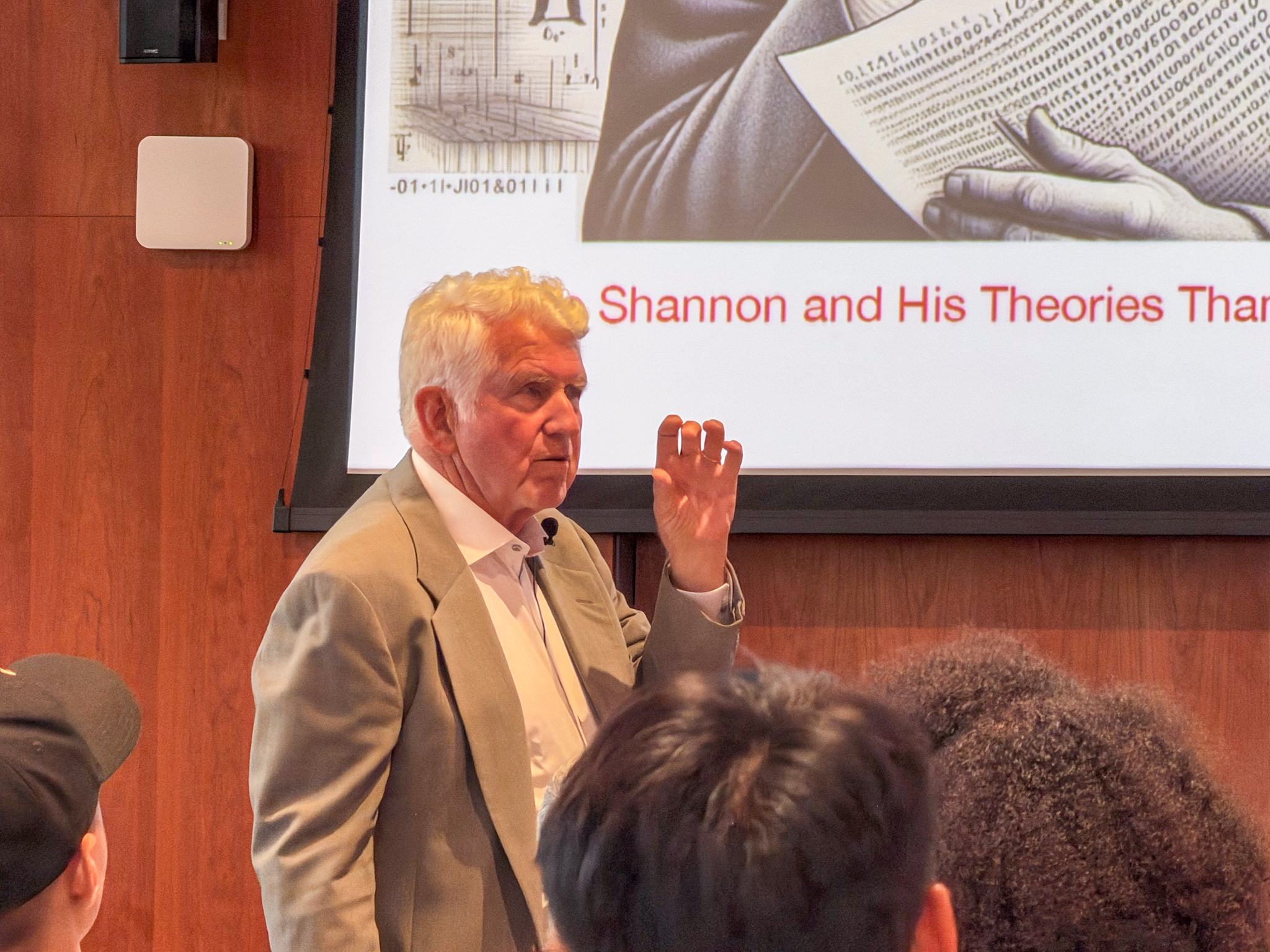
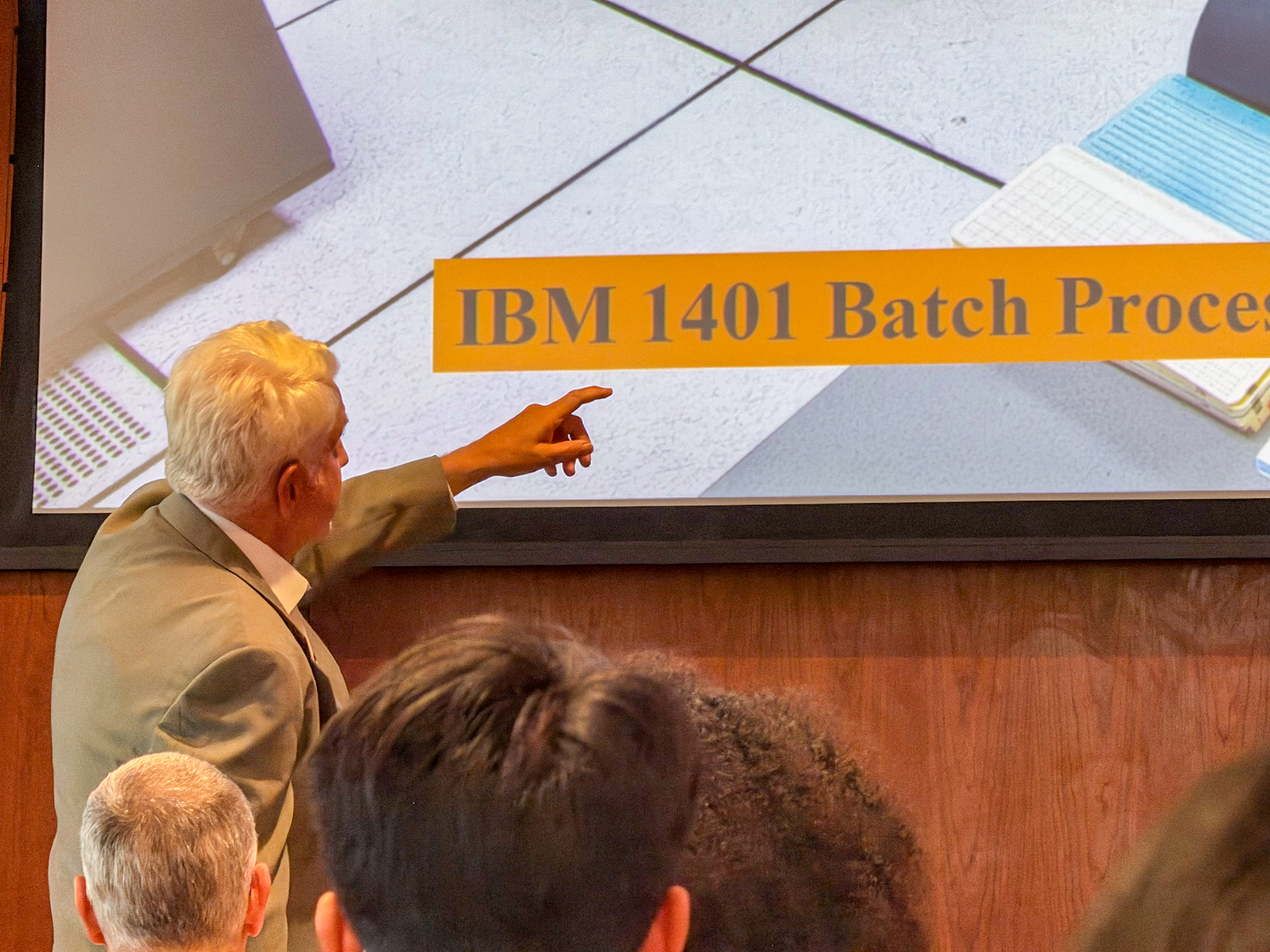
"Latency is the current hot topic in networking. Nothing new. Question, yeah. So this is a picture of my personal computer in the fall of nineteen sixty-five. It's an [00:05:30] IBM 1401. You punched cards over here on the right. In other words, you take your computer program and you punch them into a card. Then you take a bunch of cards in a deck — this is where the word 'deck' originated — and you feed it into a card reader, and then the card reader reads it. Then the processor — here's the processor over here — it processes the cards and then prints your error messages on that great big printer over there. And so the modus [00:06:00] operandi is you work all day on your program."
"You take it to the comm center at four o'clock in the afternoon, drop it off, and then the next morning you come and pick up your printout, which generally was just — Hey, Bob, I got a question. Did you ever meet Claude Shannon? I never met Claude, no. He was at MIT around then. Okay, thank you."
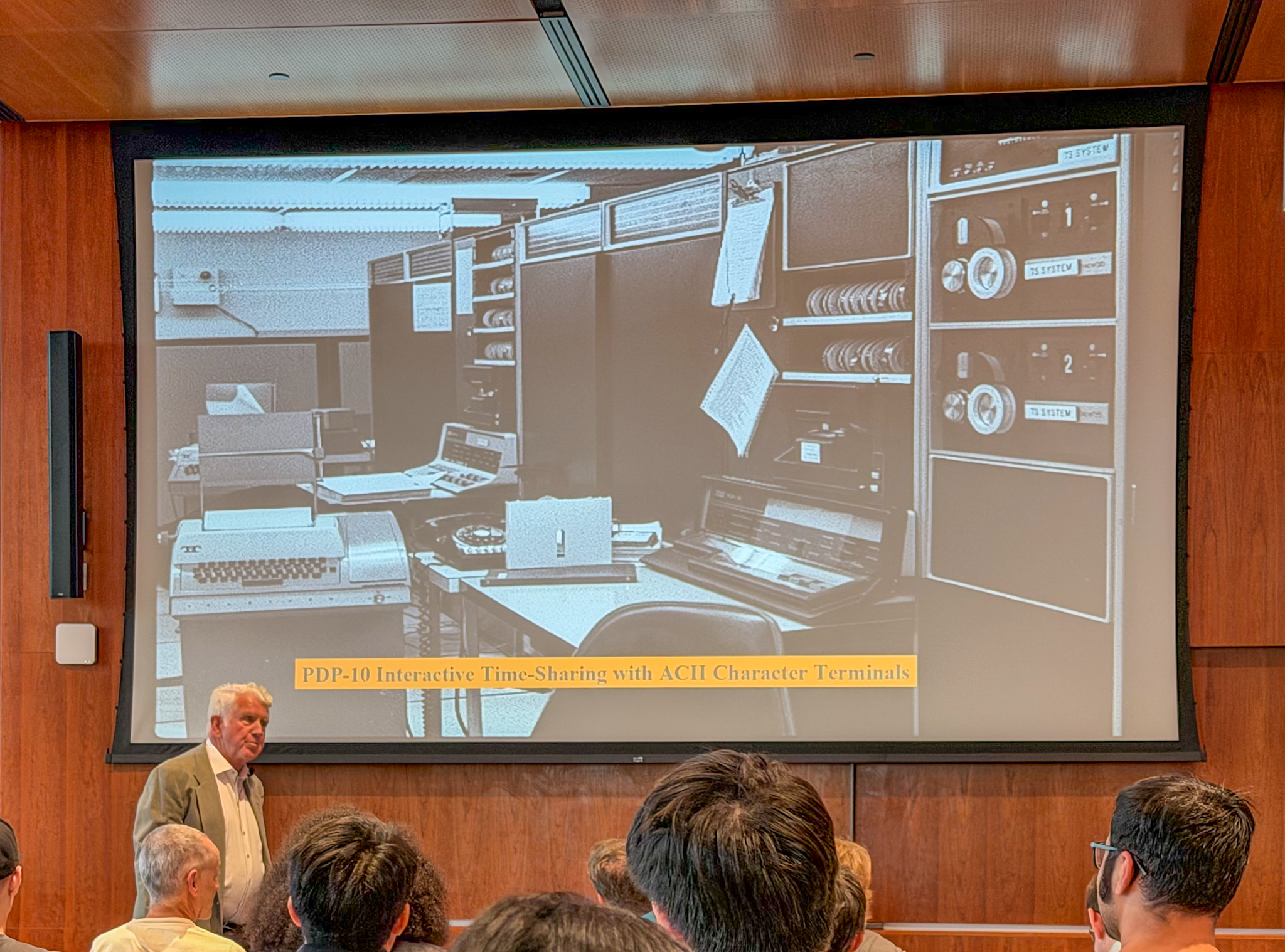
"Right. So you got me. I've never met Claude yet. His name has been — it's in comeback mode now. How [00:06:30] many of you are Claude users? This was the new wave of computers in the '60s, interactive time sharing. These are two PDP-10s. One over there, one over there. And this is the terminal."
"This is how you talked to a computer in those days. This is a teletype with paper, and so you would type into your program, and your [00:07:00] program would give you answers a few seconds later. It was a huge improvement over the punch card. And this was the computer that ARPA decided to put on a network."
Resource Sharing and the ARPANET
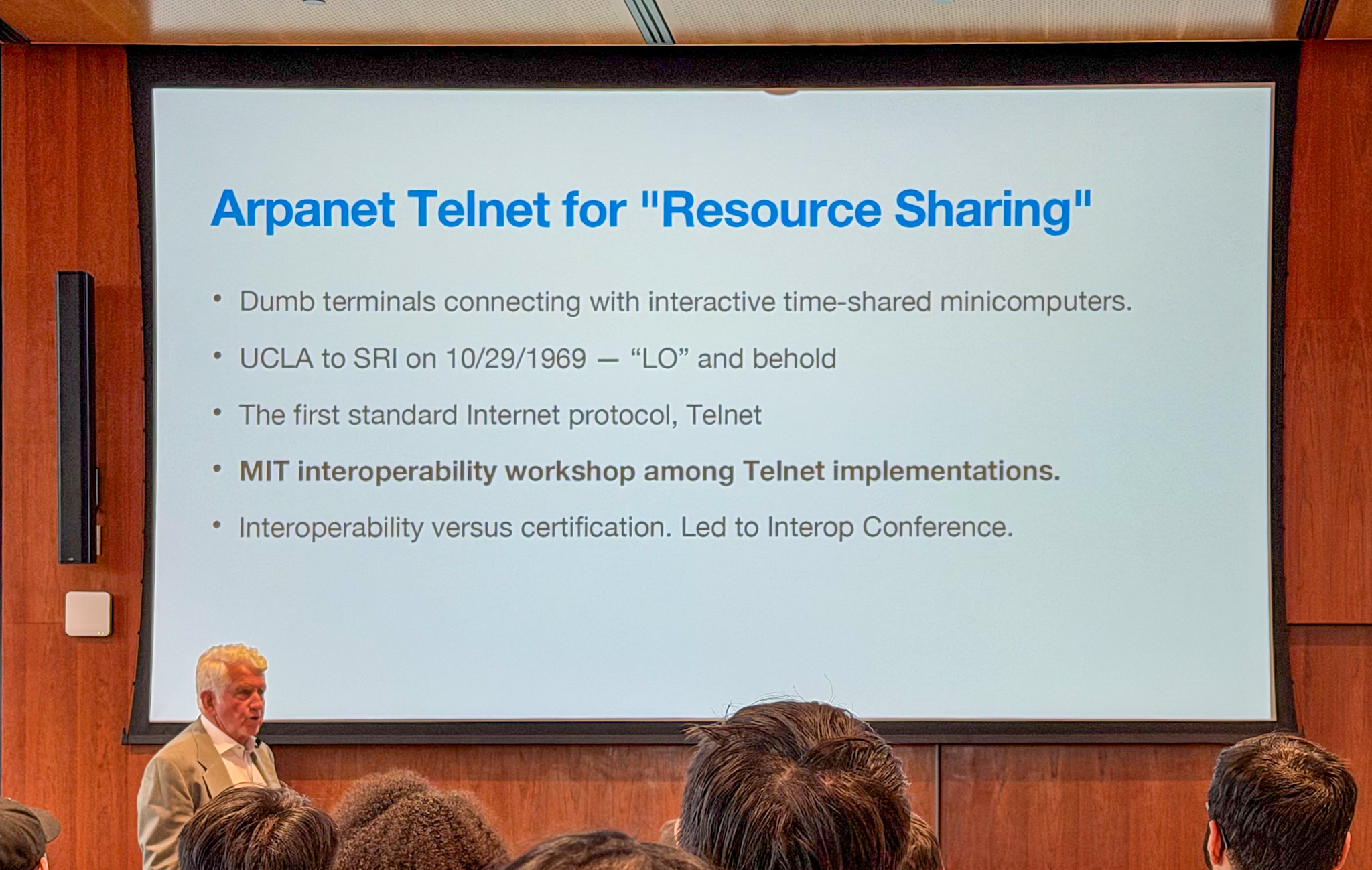
"It was to be a network of PDP-10s. And so we started working on what ARPA, the funder, called resource sharing. So the original use of the internet was resource sharing. What they meant by that was they didn't have to buy a PDP-10 for every [00:07:30] university. They wanted to be able to buy a few PDP-10s and then have everybody else network in through the resource sharing network."
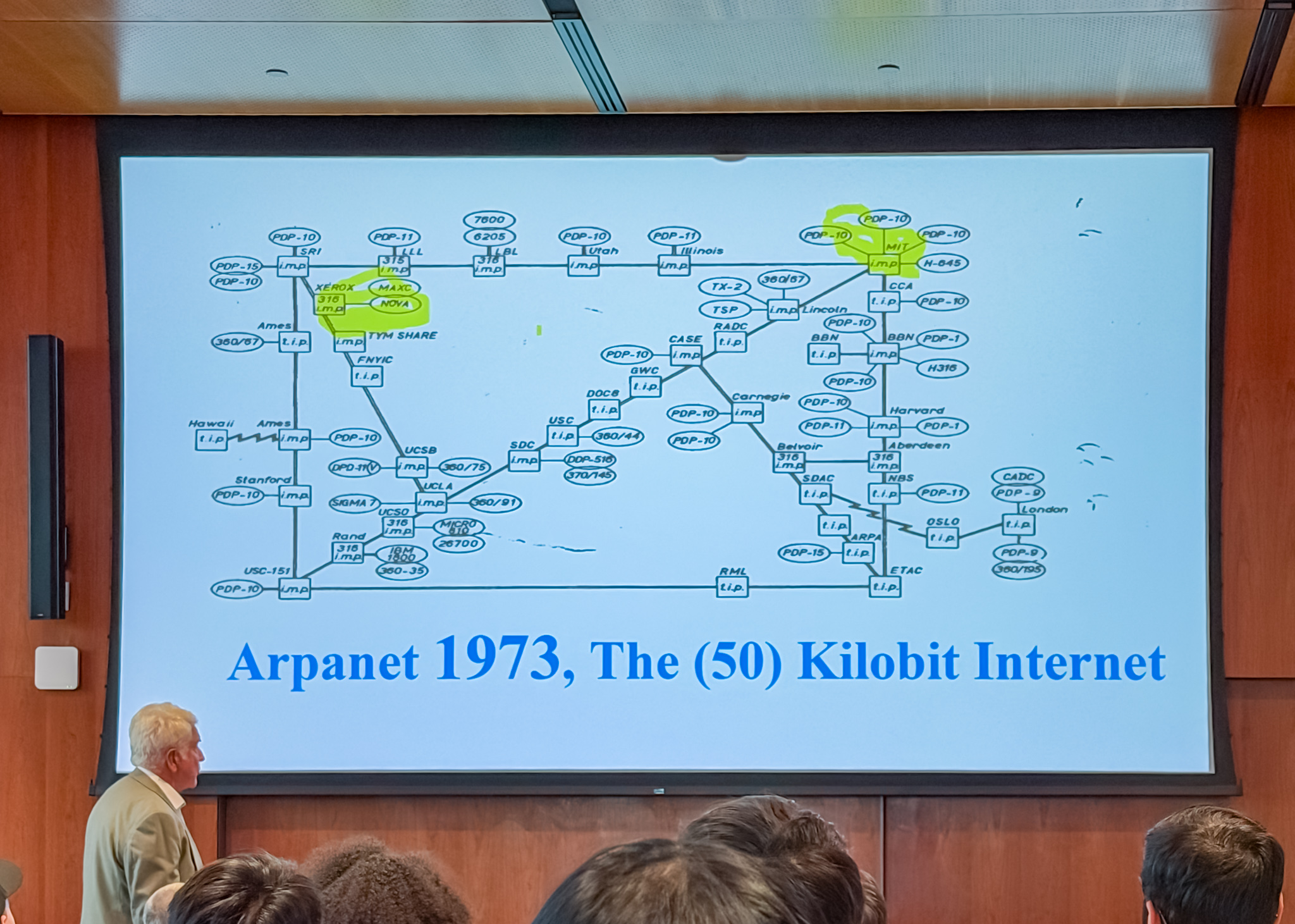
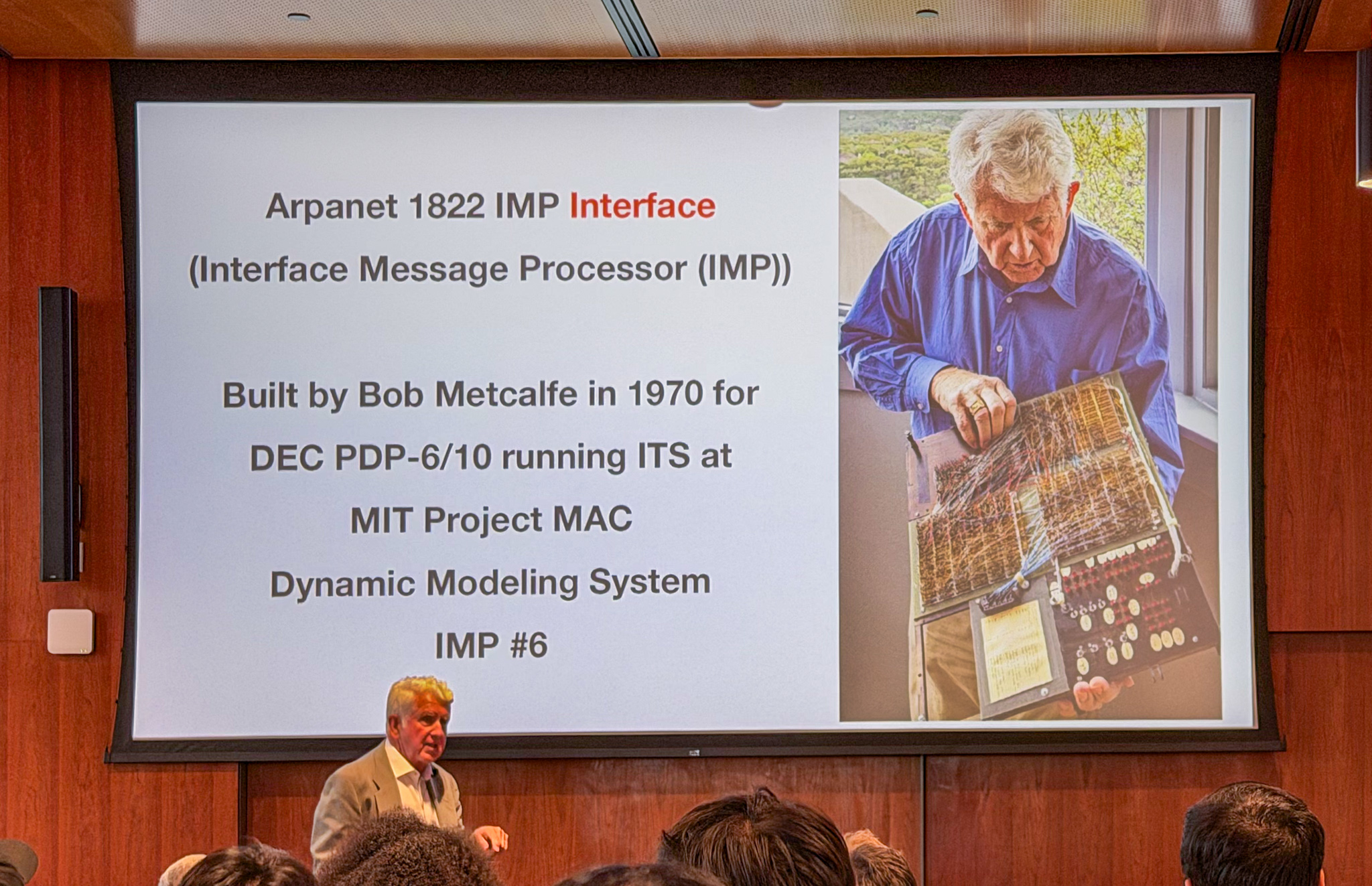
"So networking dumb terminals was the original use of the internet, circa nineteen seventy. And what I did — this is how I got involved — I built this device, which stood between our PDP-10 at MIT [00:08:00] and this packet switch. And the packet switch was like a refrigerator that took data packets and sent them around the world."
"So this is what the internet was like in nineteen seventy-three. And I like to think of this — this circuit that goes coast to coast ran at fifty kilobits per second. And I notice the prefix 'kilo' has dropped out of use. And so these are the yellow areas, highlighted, the [00:08:30] two areas of this network where I put MIT — one of MIT's computers — on this network, and then I moved to Xerox Palo Alto Research Center and put — the first job they gave me was to put Xerox on the internet."
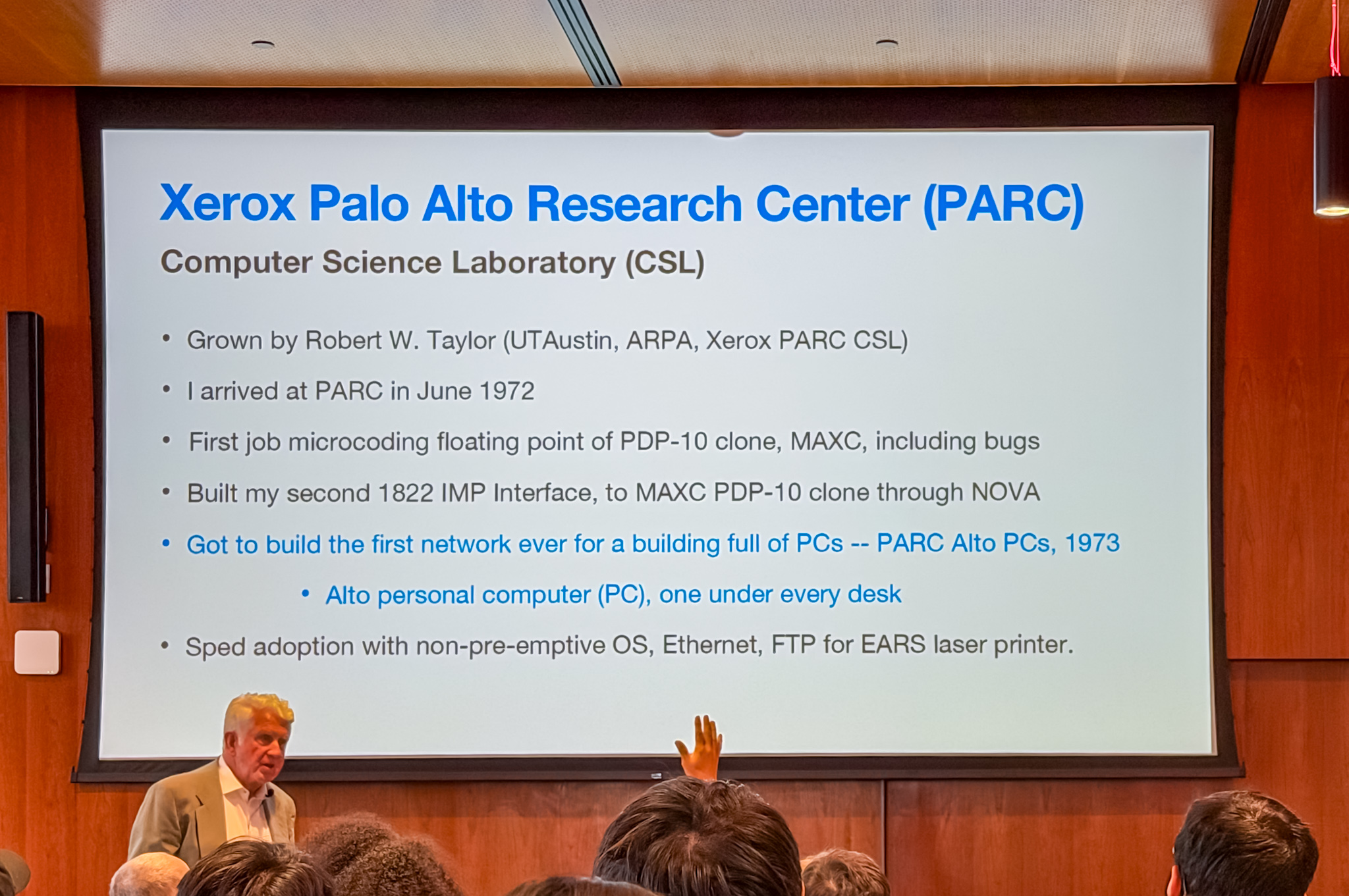
"And so as the Internet is going faster and faster and faster, as you'll soon see, the terminals were getting smarter and smarter and smarter. Thank you for your question. [00:10:00] This was the terminal when we started. It went from paper to glass sort of midway, and finally, the first personal computer — and we could have a whole argument about whether it was the first personal computer."
1973 · Inventing Ethernet at Xerox PARC
[00:10:30]"This is what they built, what we built at the Xerox Palo Alto Research Center. It's the source of my great luck. I was given the job of networking that baby, which was the job of a certain — 'one on every desk.' I thought, 'Who would want to do that?' We wanted to do that."
"So here's a picture of me before — just to give an idea, in the upper right-hand corner here is a Texas Instruments Silent 700, thirty characters per second on paper [00:11:00] with an RS-232 cable running at three hundred bits per second. And that was the top-of-the-line internet terminal. Up there at the tippy top is a box of 35-millimeter slides."
"We didn't have PowerPoint, so we took slides with a camera, and we developed them as you would a camera, and put them in a carousel, and showed them the presentation. [00:11:30] This is a Rolodex. You don't see it? This is that telephone again. These are pencils. And that's my office in Palo Alto, as I began typing the memo inventing Ethernet."
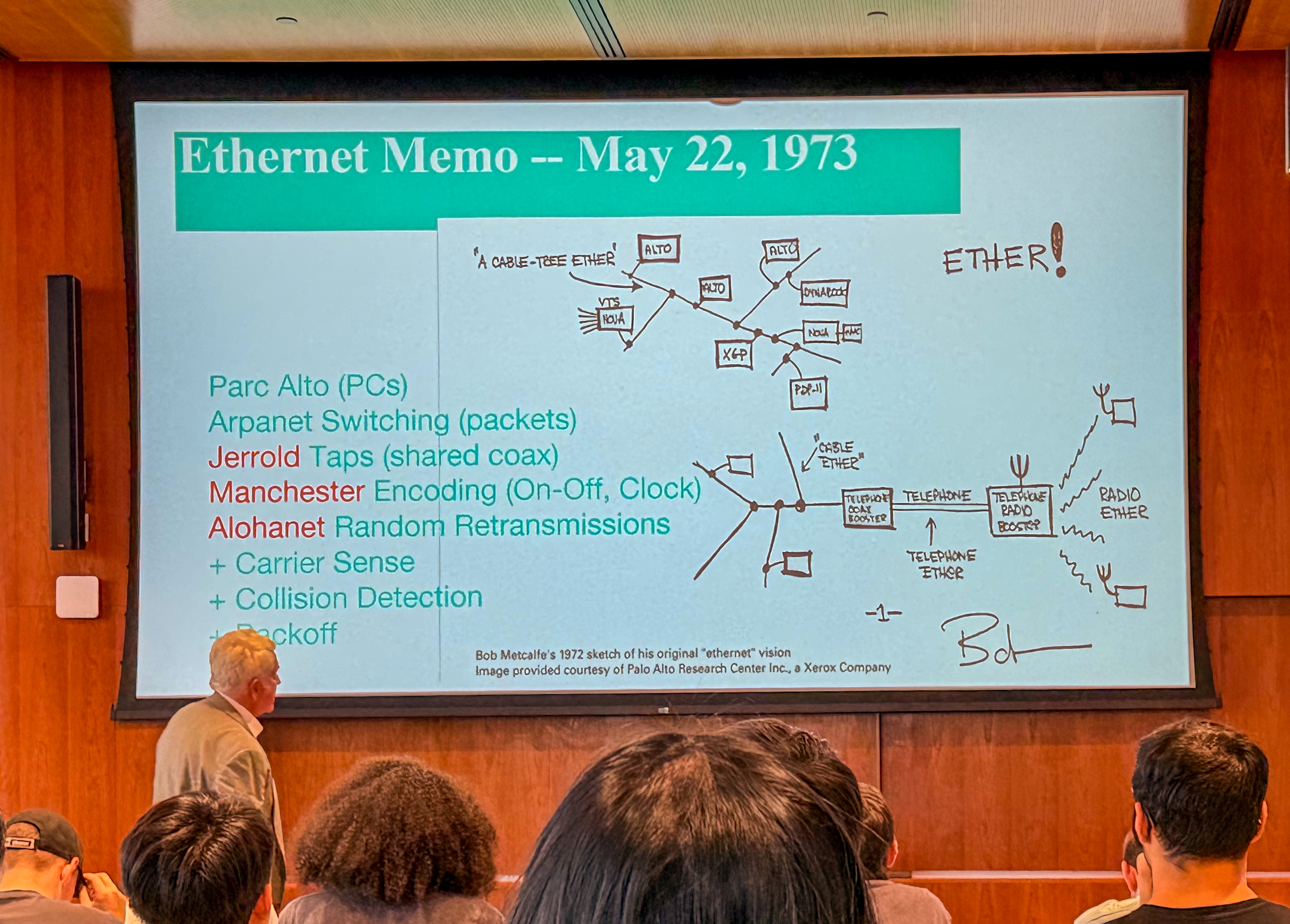
"And there's the documentation of the memo, which I wrote on May twenty-second, nineteen seventy-three. This is a hand-done diagram from the memo. [00:12:00] You'll notice that over here is the radio ether. So ether was the name we gave to the medium through which packets were — and we called it the ether because we wanted it to be open to any medium."
"Eventually we chose coaxial cable here, but we didn't want to call it 'coax net' because that was too narrow. So we called it Ethernet, and we imagined there might be a radio version of it, [00:12:30] hence 'radio ether.' And this is where I invented Wi-Fi. And I say that just to annoy the people who actually invented Wi-Fi."
"And this is the notion of a router using a telephone circuit — to your question, yeah — to connect these two sites. And here are the shared coaxial cable. Imagine the [00:13:00] coax down the center of the corridor, and if you wanted to be part of the network, you would pierce that cable and become connected to it."
"And this version of Ethernet — I'll call the PARC version — had, ha — introduced three technologies: Gerald, Manchester, and Aloha net. Gerald was a system for puncturing the coaxial cable so that you could connect to it and send packets in and out. Manchester was an encoding that you [00:13:30] use on the bits to clock the bits out onto the cable, and the Manchester encoding was the pattern of clock ticks."
"And finally, the Aloha network, which was a packet radio network at the University of Hawaii. I'd recommend a visit still — and that was a joke. Oh, I know, I know, you don't know what a joke is. The Aloha network, I went out there. The [00:14:00] radios were this big, so there was no chance of getting it into the PC. So we didn't choose radio."
"This is where we didn't choose to do Wi-Fi in nineteen seventy-three because the radios were too big, and it would take twenty-five years, it turned out, for those semiconductors to come along [00:14:30] to make that possible. Okay. So Ethernet is being invented now in this story, and the personal computer is being built."
The Alto and the Race to Ship
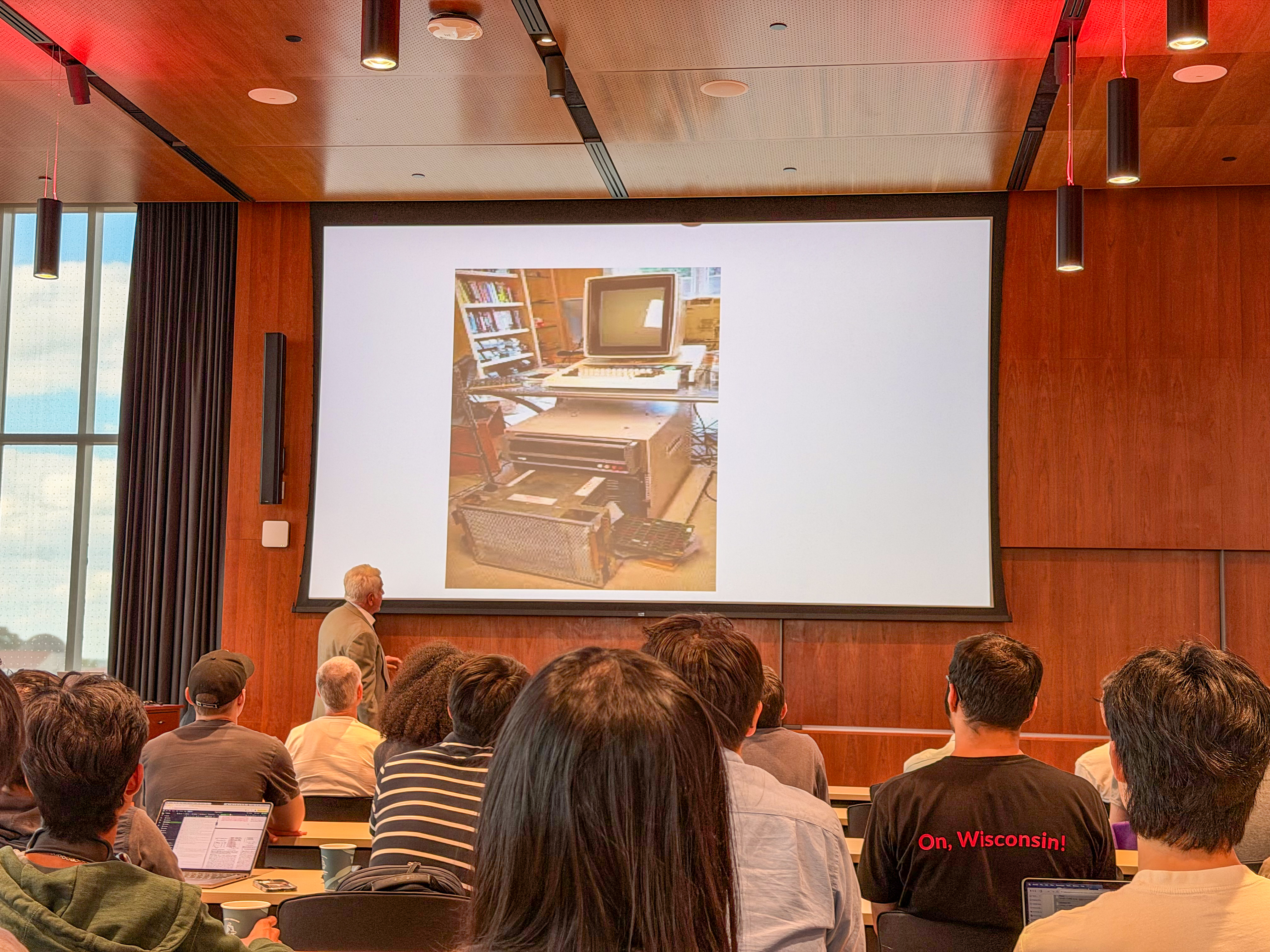
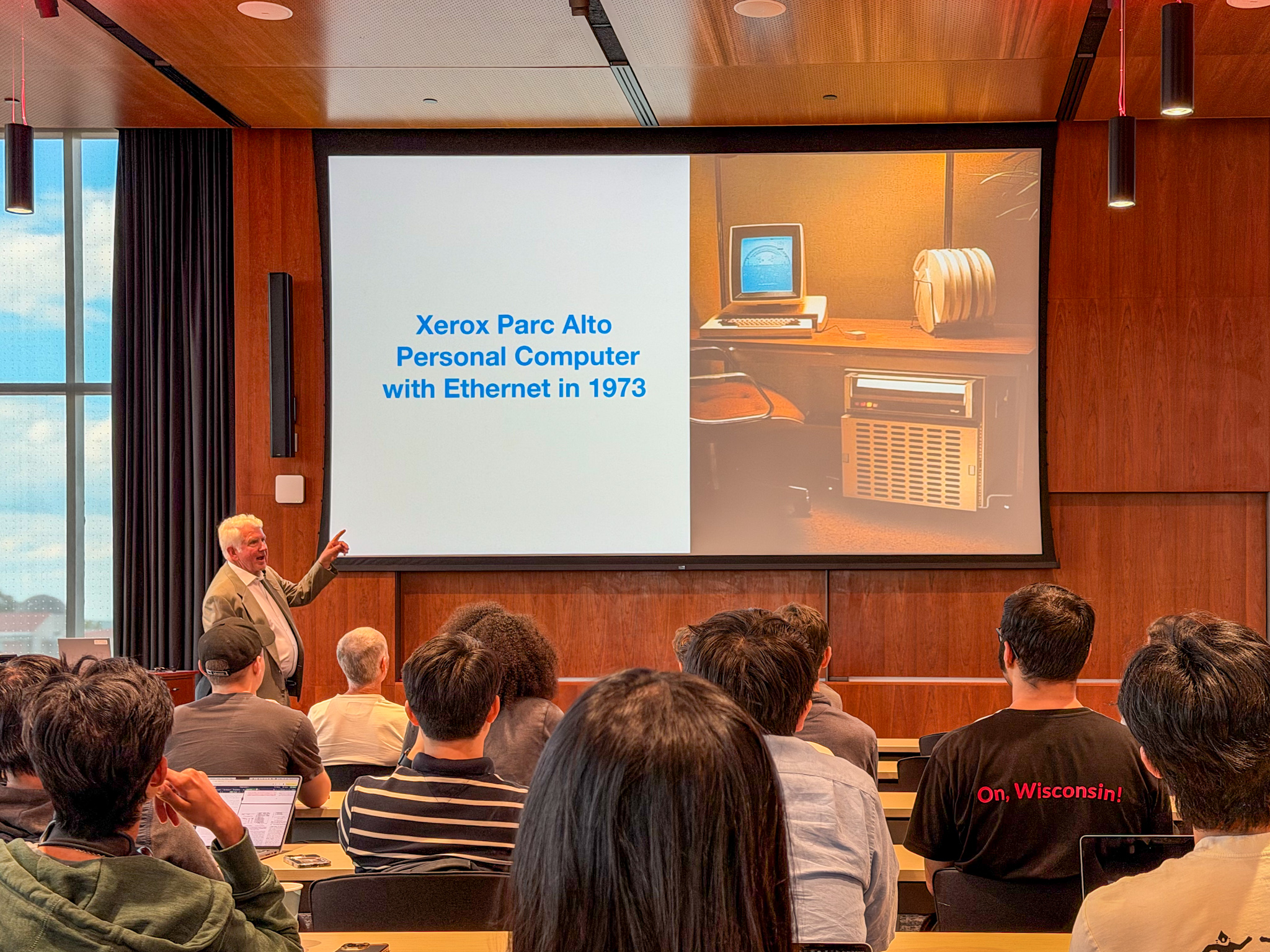
"So here's a picture of the personal computer. The Alto, it was called, from Palo Alto. And this would go under every desk. One of these under every desk. There's a removable disk cartridge which held — this disk cartridge right here, we called it the pizza box — could hold two megabytes of data. Where would you get that much data? And [00:15:00] this is the first Ethernet card plugged into an option slide extender, and this represented one of the two major constraints. One constraint was we needed to have the network working by the end of nineteen seventy-three, or we would be killed — 'cause a bunch of other people were building their PC, and they wanted a network when they were far enough along."
"The other constraint was this card. David Boggs and I — may he rest in peace — [00:15:30] we debugged that Ethernet card. It could hold sixty chip dual inline packages, at a much lower density than y'all are used to. A single chip could hold two flip-flops, six inverters. It was — but we managed to squeeze it onto the card, and that's an important constraint."
"We had to get it done on time, and it had to fit on that card. And you would think [00:16:00] that such a brilliant design would be an automatic slam dunk, but no. As soon as we showed Ethernet, we had competitors. My favorite competitor was Sneakernet. If you've ever built a network, you know about Sneakernet."
[00:16:30]"But instead, we embedded Command-P, or sometimes called Control-P. We print the document that's on my screen, and it would automatically go down the Ethernet to the printer. Anyway — another of the competitors to mention is [transcribed elsewhere as "SIGAP" — rendered here as] SigNet. He was a young grad student working on his network, SigNet, when I arrived at Xerox PARC. His name was Charles Simonyi. He is Microsoft's [00:17:00] billionaire number four."
"They asked him to stop working on the network. Of course, Metcalfe is the networking guy. So he went to go do Microsoft Word, and is a billionaire. And he was convinced to stop work on SIGNet, which was basically a fifty megabit per second version."
[00:17:30]"By the way, Ethernet won this competition, and I cheated. They gave me the job of building the operating system for the world's first laser printer, using an Alto as the controller, and then this — you can see a picture of it there — this huge Xerox copier converted with lasers. So I made it so that the only way you could print a document on this printer was through Ethernet."
"And that meant [00:18:00] everybody who had a PC in the building needed one of my cards to plug in so they could be on the Ethernet, so they could print their memos on this machine."
"So there it is. That's the Xerox Alto. You can't see the Ethernet 'cause it goes out the back. But you can see the bitmap display. You can see the mouse. You can see the two-megabyte [00:18:30] removable disks, the pizza oven, and this is where the option cards were for the PC. So I left Xerox in early nineteen seventy-nine."
Founding 3Com
"There's no way that we would fight IBM, which at the time was the second largest computer company in the world. Yeah, then I left. That's when the whole company went down the toilet." (There's a stone with your name on it out front with you there.) "No, we partnered with DEC. So [00:20:00] DEC, Intel — a brand new semiconductor company founded in nineteen sixty-eight — and Xerox formed a group called DIX, D-I-X, joined by my startup called 3Com, to promote Ethernet as a standard."
"And so that group produced an Ethernet spec and submitted it to the IEEE for standardization. And that decision to make Ethernet an open standard was all-important to its success, 'cause the customers wanted [00:20:30] to be able to connect all their equipment together, and we were gonna offer them an opportunity."
"So I left Xerox — not exactly. I lived in Silicon Valley. So when you're in Silicon Valley, and for any reason at all, you go start a company. In fact, there's a lot of companies out here that you start. It's great to see. So I started a company, but I didn't know what it was gonna do. And then one day in June, as I was incorporating on June fourth, the phone rings, and it's a guy named [00:21:00] Steve from a city called Cupertino, in a company called Apple, and he wanted to talk to me about being his networking guy."
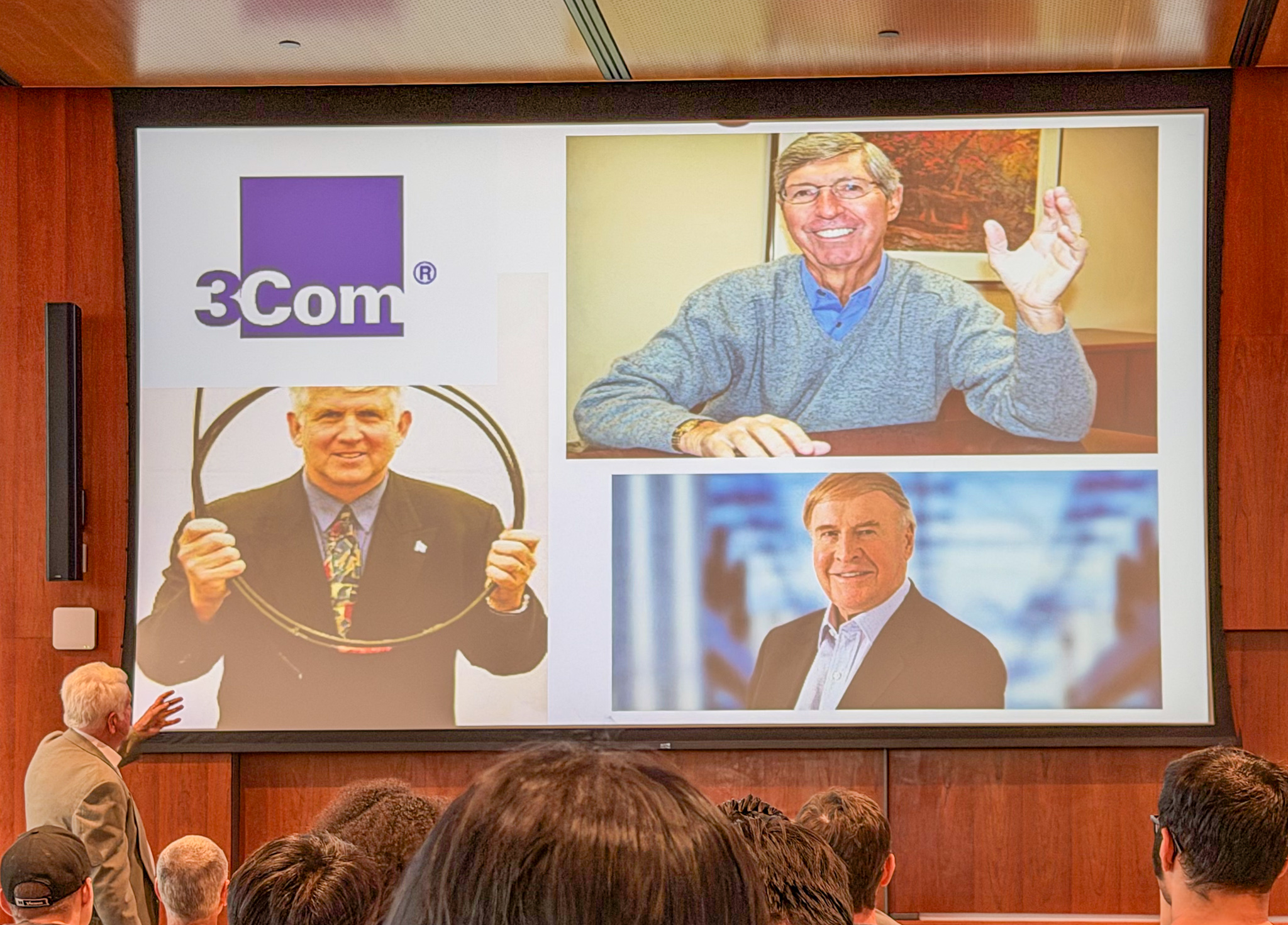
"So, by the way, I'd never heard of any of these three, so it was just a hunch. So I went and had vegetarian food on Stevens Creek Boulevard in Cupertino with Steve. The Steve — you know who I mean, like, the Steve. Word has reached Wisconsin about Steve. Anyway, [00:21:30] Steve and I had lunch, and I went prepared to sell him something 'cause I had a new company."
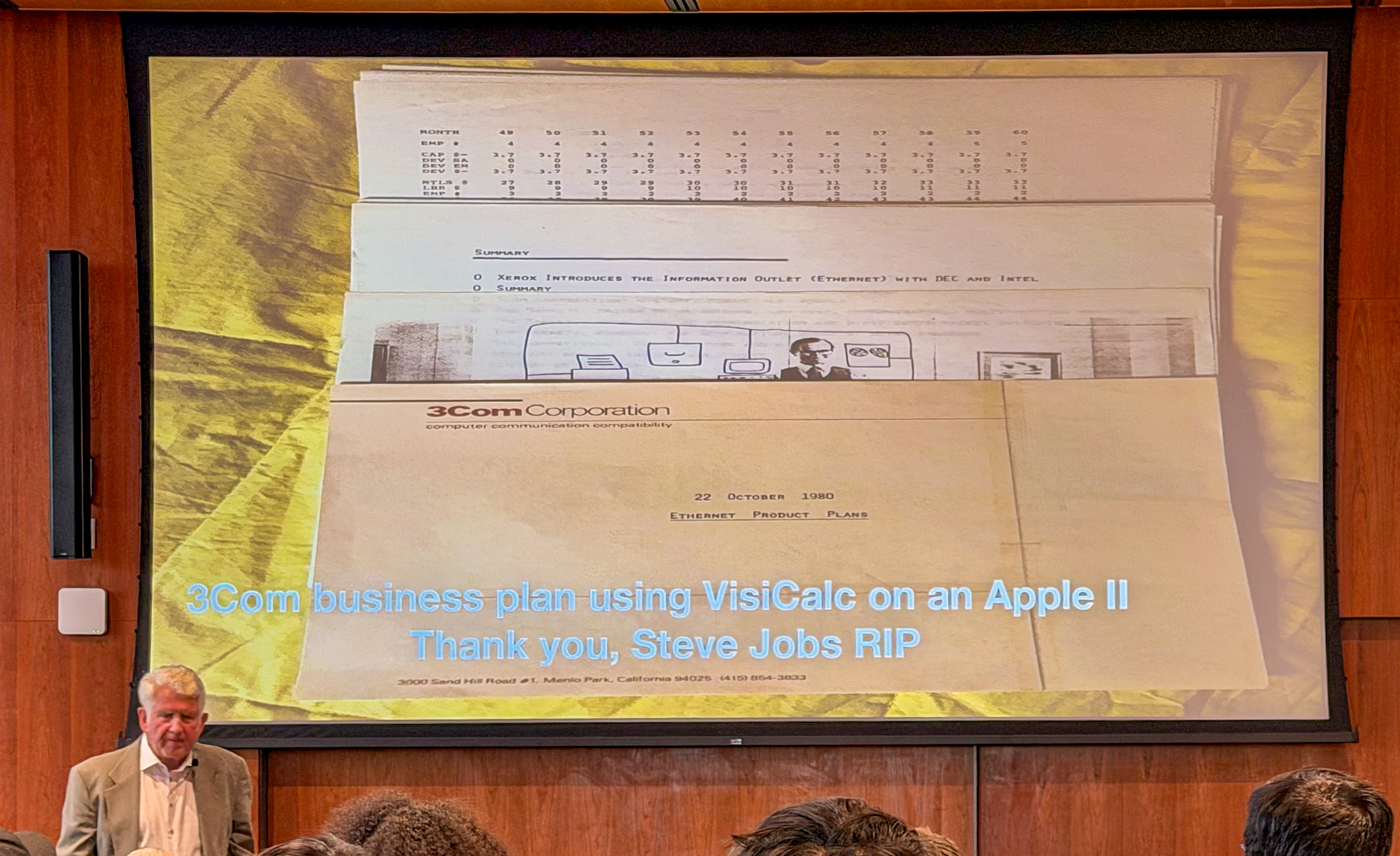
"He went as a recruiting — I flatter myself, I assume it was recruiting. And he asked me about running a company, and I told him I had just founded my own company and would he like to buy my first product. My first product was called Orchard. Get it? Steve didn't get it. And as we continued down [00:22:00] this recruiting path, I never — I only sold him stuff later. He was very helpful to our company for all the nineteen eighties. I — he didn't make me do anything. He made me buy an Apple II, and he made me buy a copy of VisiCalc, the world's first spreadsheet. And so I did a business plan, and there it is. You can see the spreadsheet in the way to the top."
"And then, in [00:22:30] September of nineteen eighty, I took this plan and went out and raised —"
"And this is what we got, the classic Silicon Valley triad: the entrepreneur, the investor, and the adult supervision. Adult supervision is a very important concept, and Steve Jobs knew about this too. A lot of people think that Steve was a great CEO. He [00:23:00] founded Apple in seventy-six. He became CEO in ninety-six."
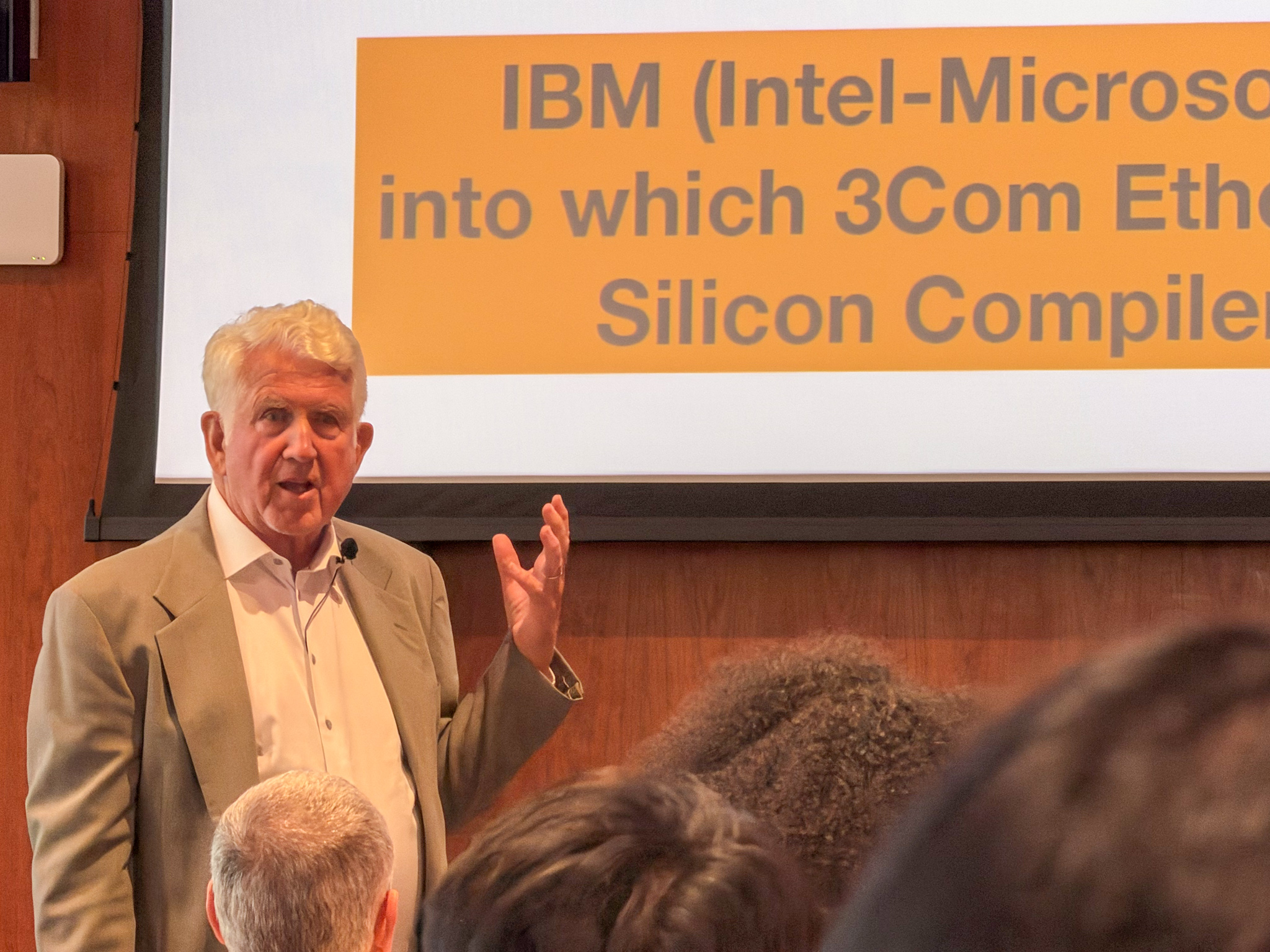
"Steve appointed a series of adult supervisions between seventy-six and ninety-six before finally becoming CEO himself. So I got some supervision. Made sense. I'd just spent the previous ten years as a researcher, and now I have a company and a million dollars in — drugs, Cokes. We used to argue about [00:23:30] whether the discount on the Coke machine should be fifty cents or a dollar."
"Should we give our employees the benefit of dollar Cokes or fifty cent Cokes? Apparently the idea of Cokes has caught on. So anyway — supervision, investor — this is the classic Silicon Valley triad. And then a wonderful thing happened. Here's a company whose purpose is to make Ethernet to connect personal computers, [00:24:00] knowing that the world had no personal computers to speak of."
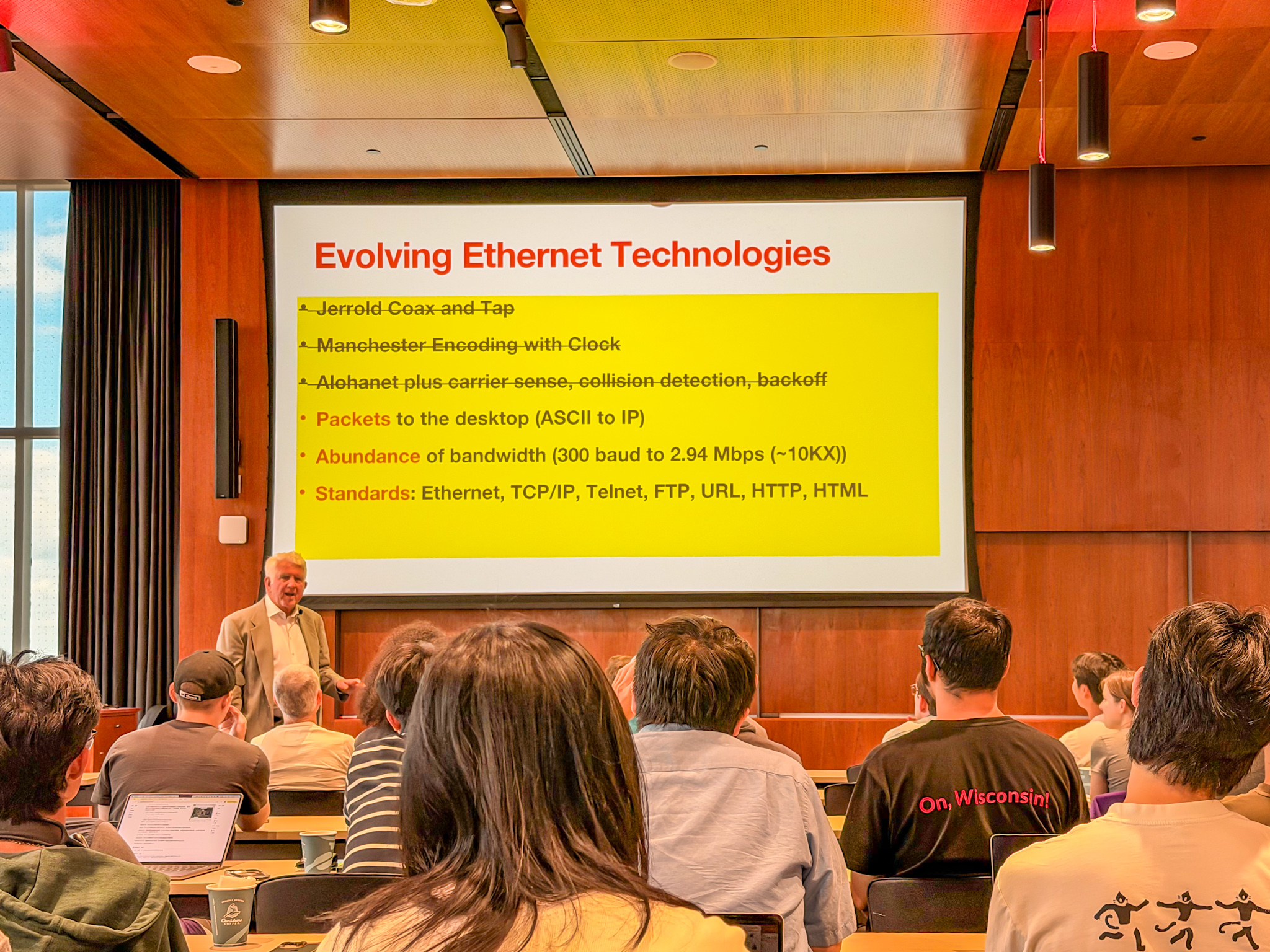
"And along comes IBM and introduces the IBM PC in March of eighty-one. And 3Com, busy as a bee — beaver — managed to create an Ethernet card that would just walk into that PC and put it on an Ethernet. And we shipped that product in nineteen eighty-two, and we broke a rule. [00:24:30] You're never supposed to take two startups and make them rely on each other, because the product of two numbers less than one is even further less than one."
"Well, here's four startups that we — Silicon Compilers designed the chip, the first Ethernet chip. [unclear: transcribed as “Syncfab”] did — another startup. My company put it into a system with software, and BusinessLand sold it through [00:25:00] retail. And only because all four of those startups showed up on time. Very unlikely. Don't ever do this."
"We did it, and it worked, and so we took off like a [unclear: "lion ship" — possibly "rocket ship"]. We tried selling Ethernet cards to IBM customers, and we learned that was not ever gonna happen. We had to wait for those people to die. They were basically IBM employees. So what we did is we went [00:25:30] through retail — to not the CIOs of companies, but to the working people. And they appreciated it. They appreciated the opportunity to get something done, because these CIOs weren't doing it."
"So here we are in the marketplace with Ethernet, and guess what? Today's Ethernet does not have the same technologies that we started with. Remember, we started with Gerald coax and a tap into the coax, the Manchester encoding [00:26:00] for getting a clock into the packets, and the Aloha network for getting randomized retransmissions."
"By the way, the Aloha network method of getting a packet on this network is you would send the packet. If it got through safely, fine. If it didn't get through, you would take a random number, count it down, and try again. And we adopted that simplified protocol from the Aloha [00:26:30] network in Hawaii."
"But by the time we got to the marketplace, those three technologies had all been obsolete. So instead of those three, we have another three. Ethernet brought packets to the desktop. Prior to Ethernet, the internet's packets would go to a big host computer in your building, and then you would have a — a dumb terminal to talk to the app."
[00:27:00]"And with Ethernet, those internet packets would go all the way to the desk, so you could write software on your PC to send packets over the internet directly. Abundance. The terminal on my desk was three hundred bits per second. The speed of this — of this Ethernet — was two point nine four megabits per second."
[00:27:30]"So it's like a ten thousand times speed up. And part of that is ten thousand times, not ten percent times, not a hundred percent times — ten thousand times faster. So that set the precedent for the internet having abundant bandwidth so that you could upload pictures of your cats. And then standards."
[00:28:00]"Ethernet, as I mentioned earlier, was — we proposed it to the IEEE after a two-year fight with IBM and General Motors and others. It got adopted as a standard in the early '80s. The IEEE also standardized the other two competing technologies, the IBM token ring and the General Motors token bus, and they left it to the three of our companies to fight it out in the marketplace for the next ten years."
[00:28:30]"And we did, and we won. And that's how I get to be here today. We won. If we hadn't won, it would be Token bus. Token bus. Oh, IBM — yeah. Imagine coming home every day from work every day and having people say, 'Your competitors are IBM and General Motors.' So why don't you — we didn't quit, which explains a little bit of why we're so obnoxious, because we succeeded, and success has a tendency to make you obnoxious."
The Platform Kept Changing
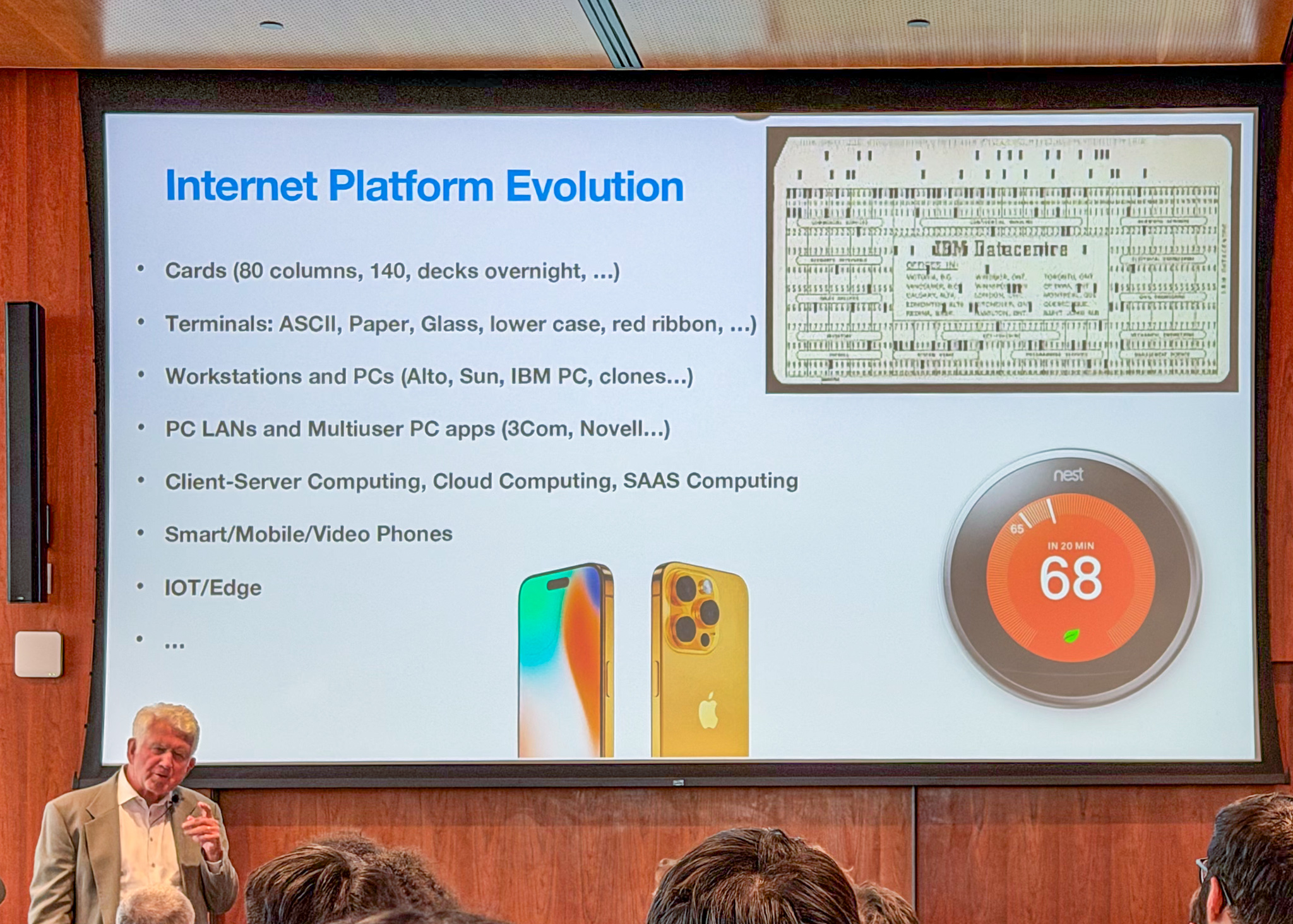
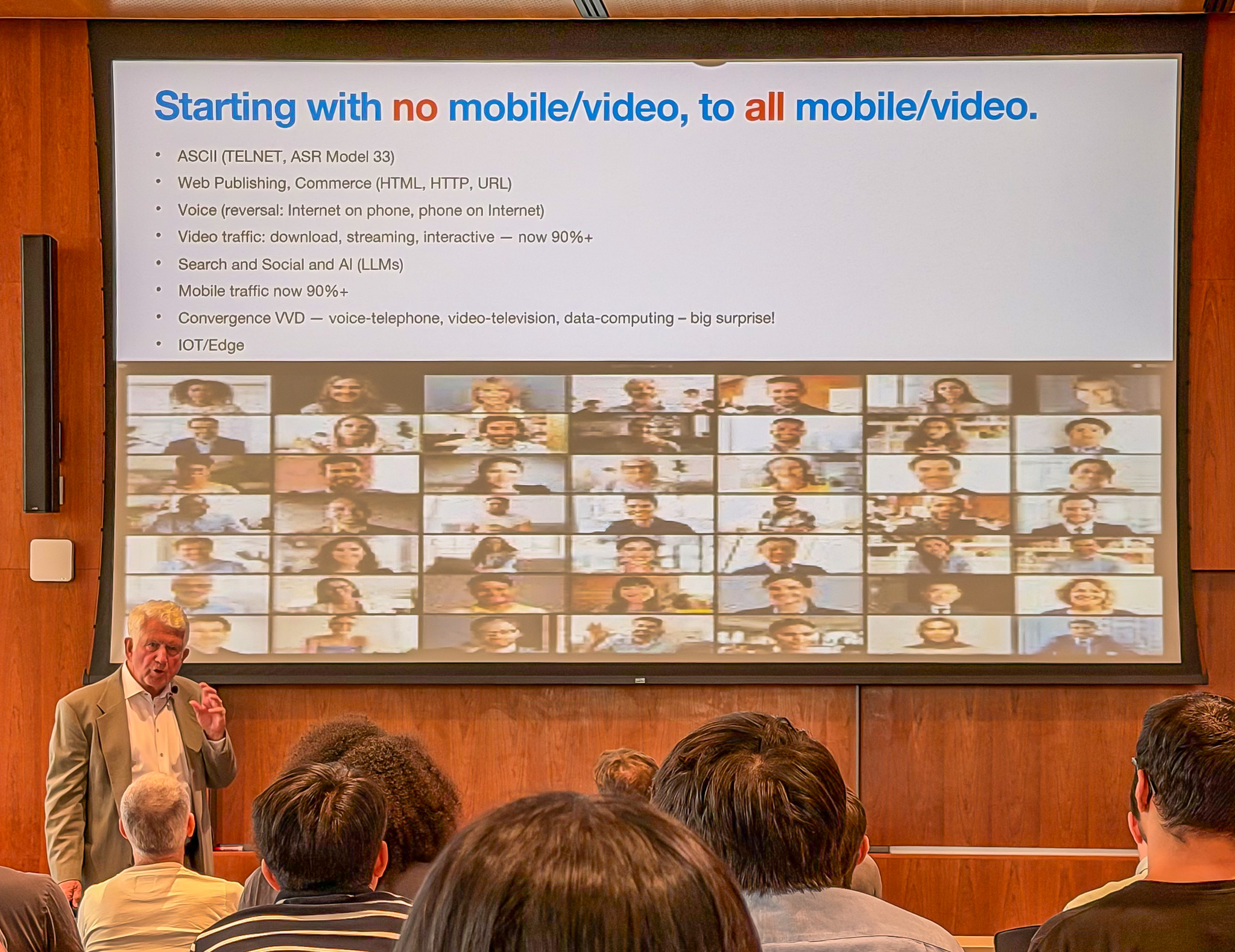
"Have you noticed that? So while we're doing all that, the platform that is the internet was changing. There's the punch cards I mentioned earlier. Here's a [00:29:00] thermostat for your house, and here — and here comes the — oh, and by the way, the iPhone did not exist during all of this time. It just arrived — what was that, what was it? And the internet was built to connect terminal — computers, workstations on desktops. It was not designed or built or anything to do [00:29:30] video or to do mobile. And now ninety-some percent of the internet is carrying mobile and video."
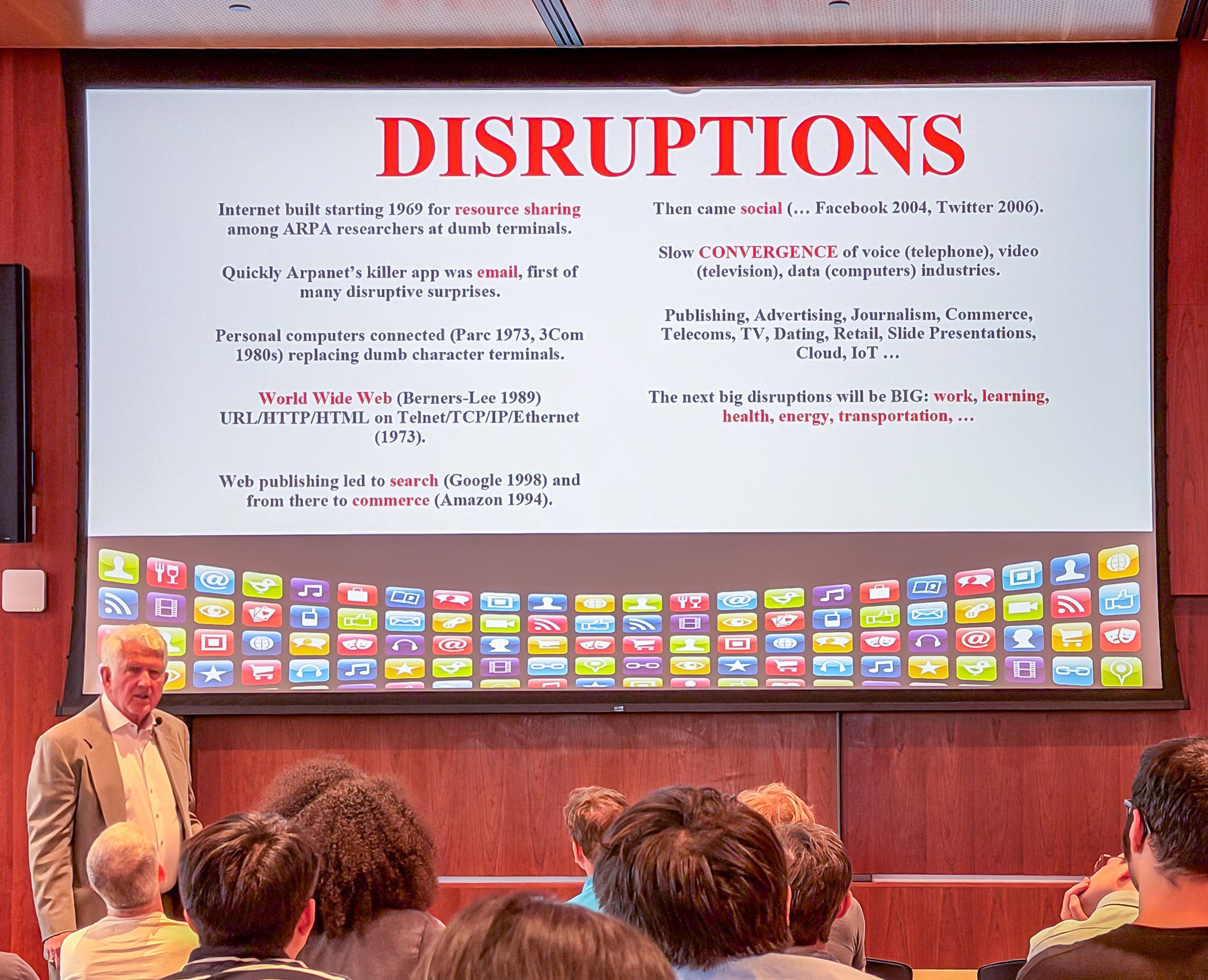
[00:30:30]"So here's my trace — lots of disruptions. So many that I've — no, no, no, this is an illegal slide. There's too many words on it. I was on the board of the company that developed PowerPoint, and they would fire me if they saw this. But here are the major disruptions. Remember, it started out as resource sharing."
[00:31:00]"In about a year, the dominant protocol, the dominant application of the Internet — within about a year, say nineteen seventy or so, seventy-one — email became the dominant app of the Internet, not resource sharing. This was a big surprise to everyone. But when the guy in charge of building out this Internet thing started using email, it was all over."
"And you could argue email is today the killer app of the Internet. Then personal computers arrived. That confused things. And then out of the blue in nineteen eighty-nine, Tim Berners-Lee invented [00:31:30] the World Wide Web and foisted it on the world. I guess it took off. The protocols, including Ethernet, were written without knowing there was a World Wide Web."
"And the World Wide Web came along, and it landed on the preexisting infrastructure and took off. And then once you had the World Wide Web, then you had search and commerce and [00:32:00] social, and then a convergence of major industries. The telephone, the voice industry — was a telephone company — got broken up in nineteen eighty-four. The video television networks, all those cable TV systems that came and went, and then the computer industry."
"So those three network industries slowly converged during this period. Then a bunch of other industries got affected — publishing, advertising [00:32:30] — still is in trouble. We still haven't figured out how to finance journalism, so in the meantime, we just make stuff up. But the next disruptions are gonna make these disruptions look small."
"We're disrupting work and learning and health and energy. Those are much bigger."
Is the Internet a Good Thing?
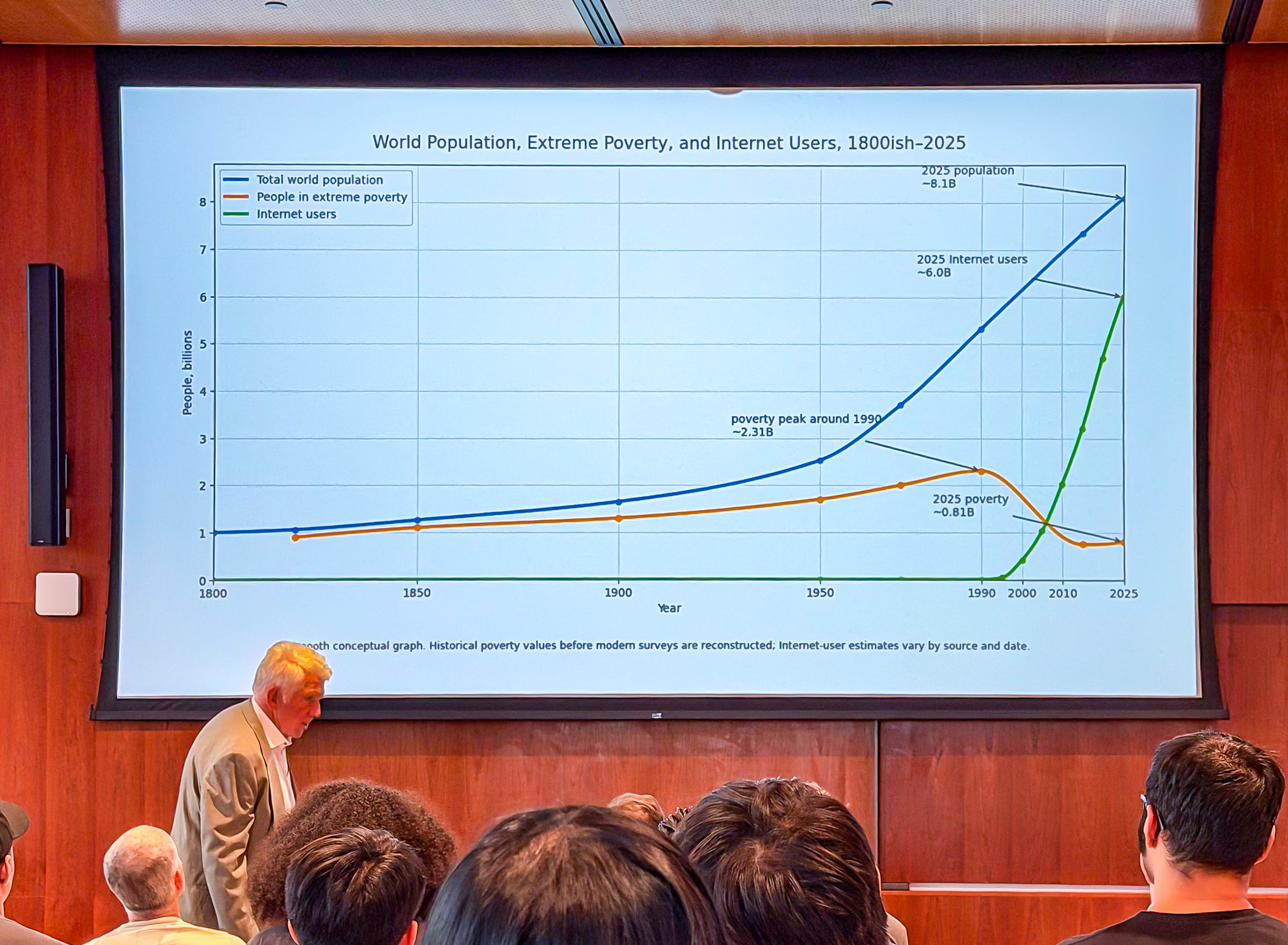
[00:33:00]"Now, is the internet a good thing? And that's being heartily debated this week, last week, next week. And I'm a believer the internet is a very good thing, and this is my favorite slide to make that point. It's a plot of population, which is the blue line, worldwide population since eighteen hundred."
"And then the orange line is people living in extreme poverty. And you'll notice for a while, everybody lived in extreme poverty. And then the population took off, but poverty — look at [00:33:30] that. Around nineteen ninety, that's five years before the internet, the World Wide Web took off. For the first time in the history of the world, poverty, extreme poverty, was reduced."
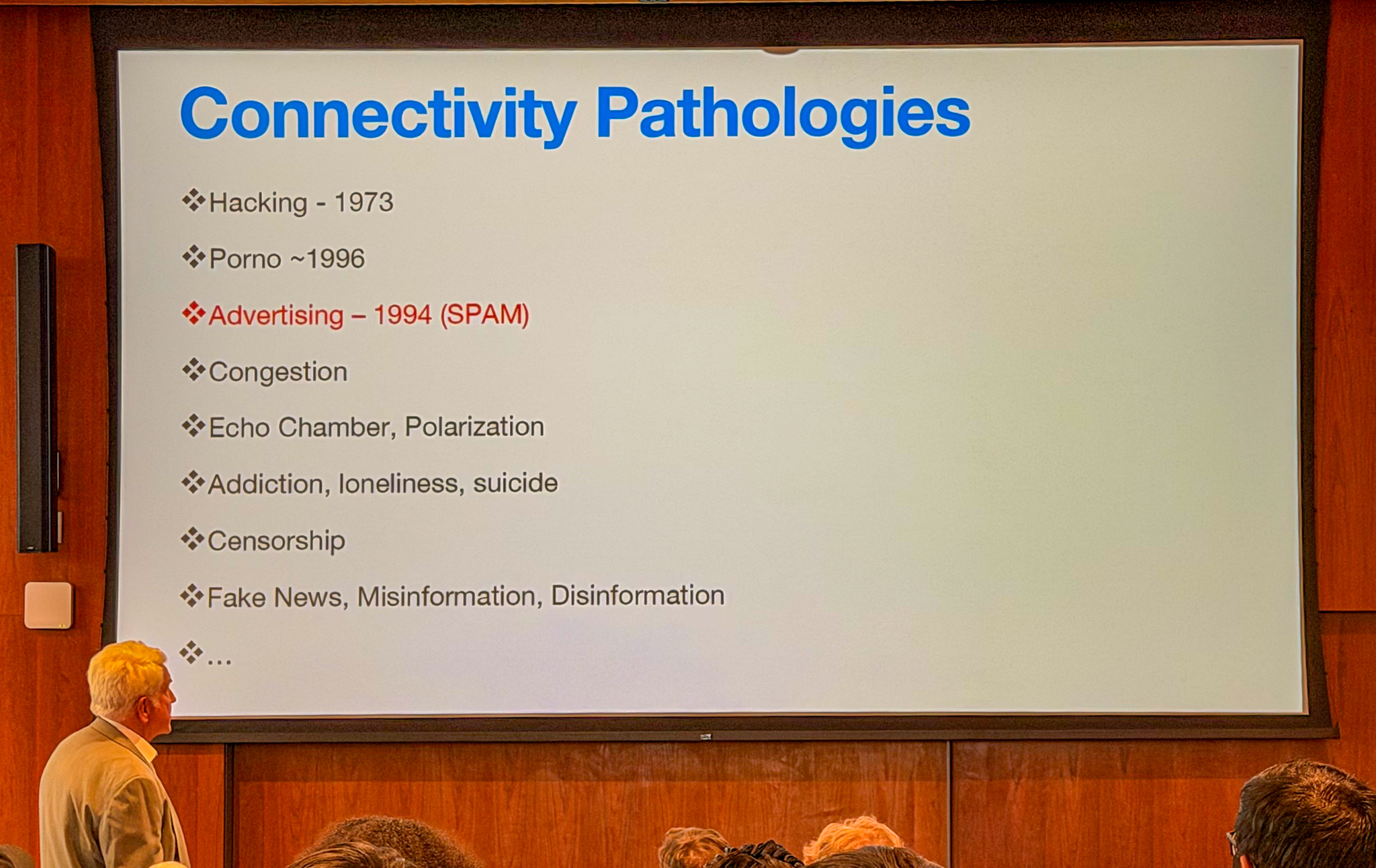
[00:34:00]"So you can say what you want about fake news. People are much smarter than — but of course, the internet wasn't — isn't perfect. And so here are some of what I call the pathologies. These pathologies arrived because bandwidth arrived so quickly. That is, suddenly the internet came in, optical fibers came in, software came in so [00:34:30] quickly we didn't know how to manage it properly, so these pathologies resulted."
"And the first one was in nineteen seventy-three, and I wrote the memo on this. Two high school students in Los Angeles managed to get somebody's password — I think it was 'admin.' And they broke into the internet in nineteen seventy-three, and I wrote a memo about it. And it's still insecure to some degree, but I want you to know it's been insecure for a very long time. [00:35:00] The next pathology is porno."
"And the Congress of the United States was about to make the internet illegal because it was so good at carrying porno. So they passed a law called the Communications Decency Act, which was subsequently declared unconstitutional. So porno has been eliminated. [00:35:30] So that was another joke that we played. And then there was advertising too. We were offended, those of us who had been investing our lives in this thing, this internet thing. Someone started advertising on our network, sending emails with ads in them. And we were offended and upset and wanted to pass laws and —"
"And then a few months later, we discovered you can make a ton of money by advertising. So let's do it. [00:36:00] And along came Google and Facebook, and advertising is now the principal thing."
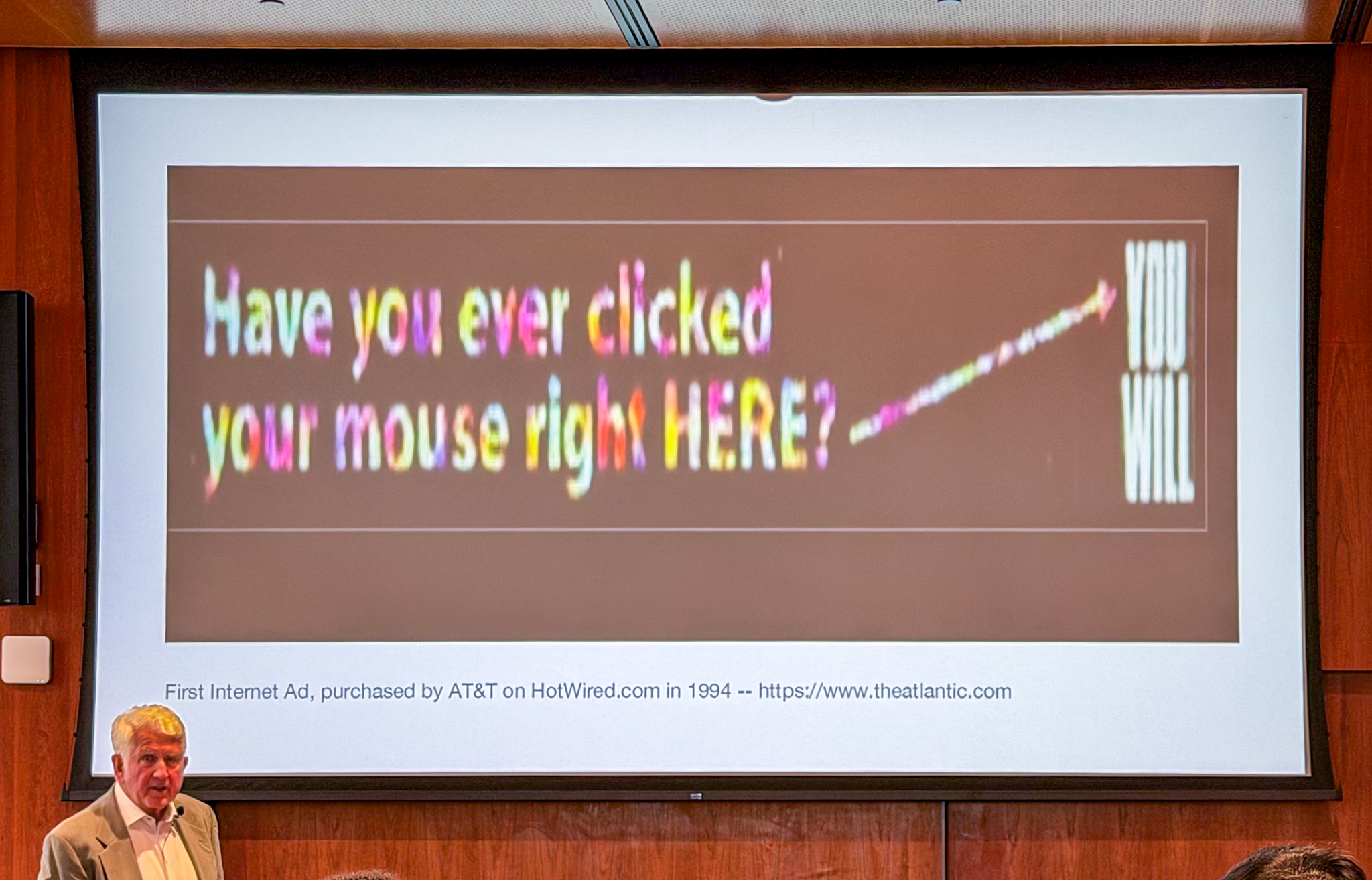
"So that's a pathology that flipped on us and surprised us. This is the first paid internet ad, AT&T, nineteen ninety-four. It's a little blurry."
Three Reversals
[00:36:30]"Now there are some surprises in this history, and I've chosen three, and I'm calling them reversals. The first one — there was an IBM executive named Roche [sic], and he plotted the cost of IBM mainframes versus their total power."
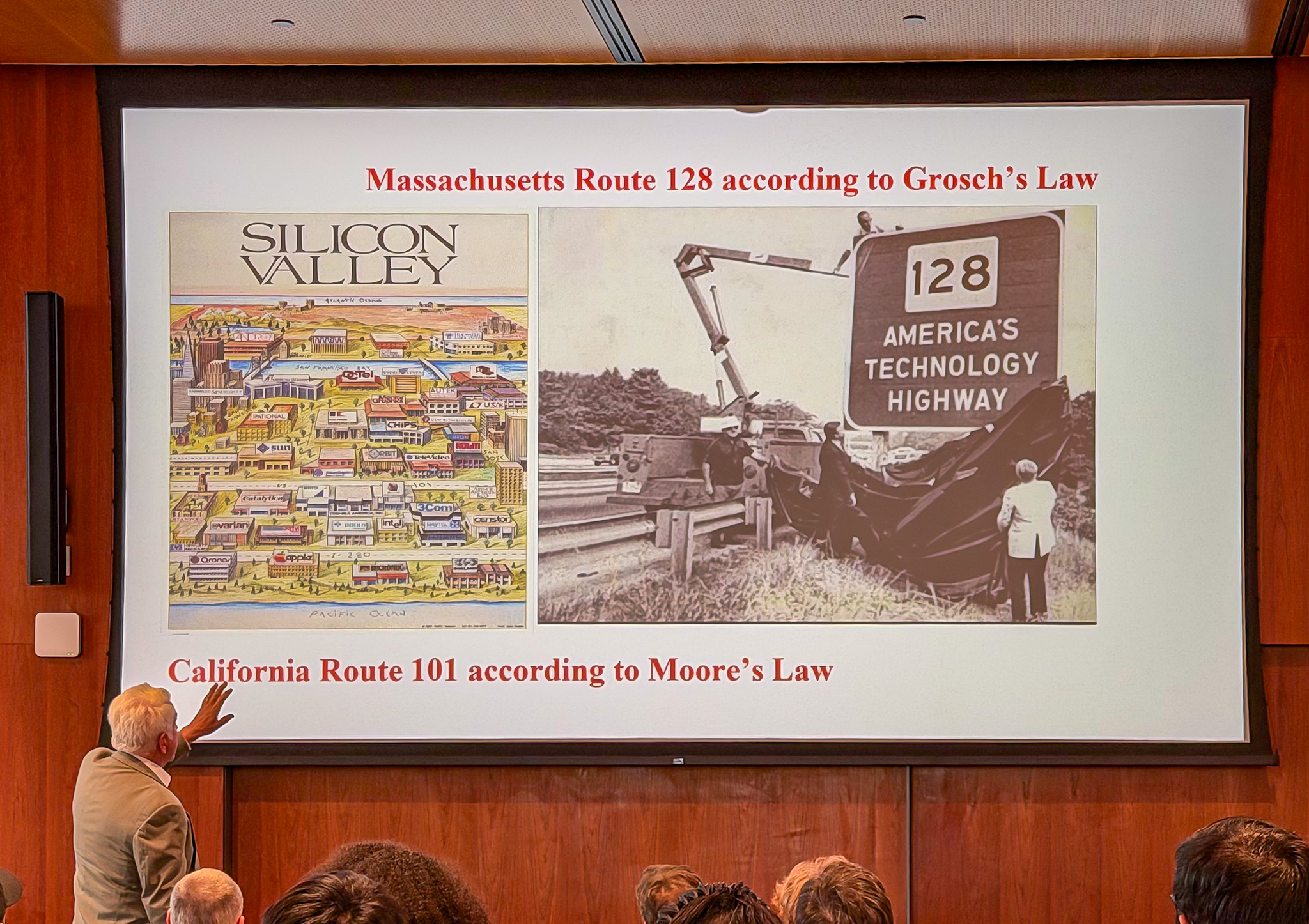
"His law, roughly speaking, is bigger computers are better. So IBM and others all went out and built bigger computers. Meanwhile, [00:37:00] across the country in Palo Alto and around, was the — Moore's Law said smaller computers are better, in essence. So you have the East Coast adopting the mainframe mindset and the West Coast adopting the PC mindset, and guess which one won? Semiconductors won. [00:37:30] And so here's a picture of a poster celebrating Silicon Valley. There's my company — see, right there, 3Com. There's Apple over here. Now my question is: was this Boston taking down the sign, or putting the sign up? I don't know. But my point is, it was [Grosch's] law that got them. It got me too. I was there. So these guys won, and these [00:38:00] guys did not win, and we ended up with the modern, non-mainframe internet. Now during — while this was happening, I became head of sales and marketing at the company."
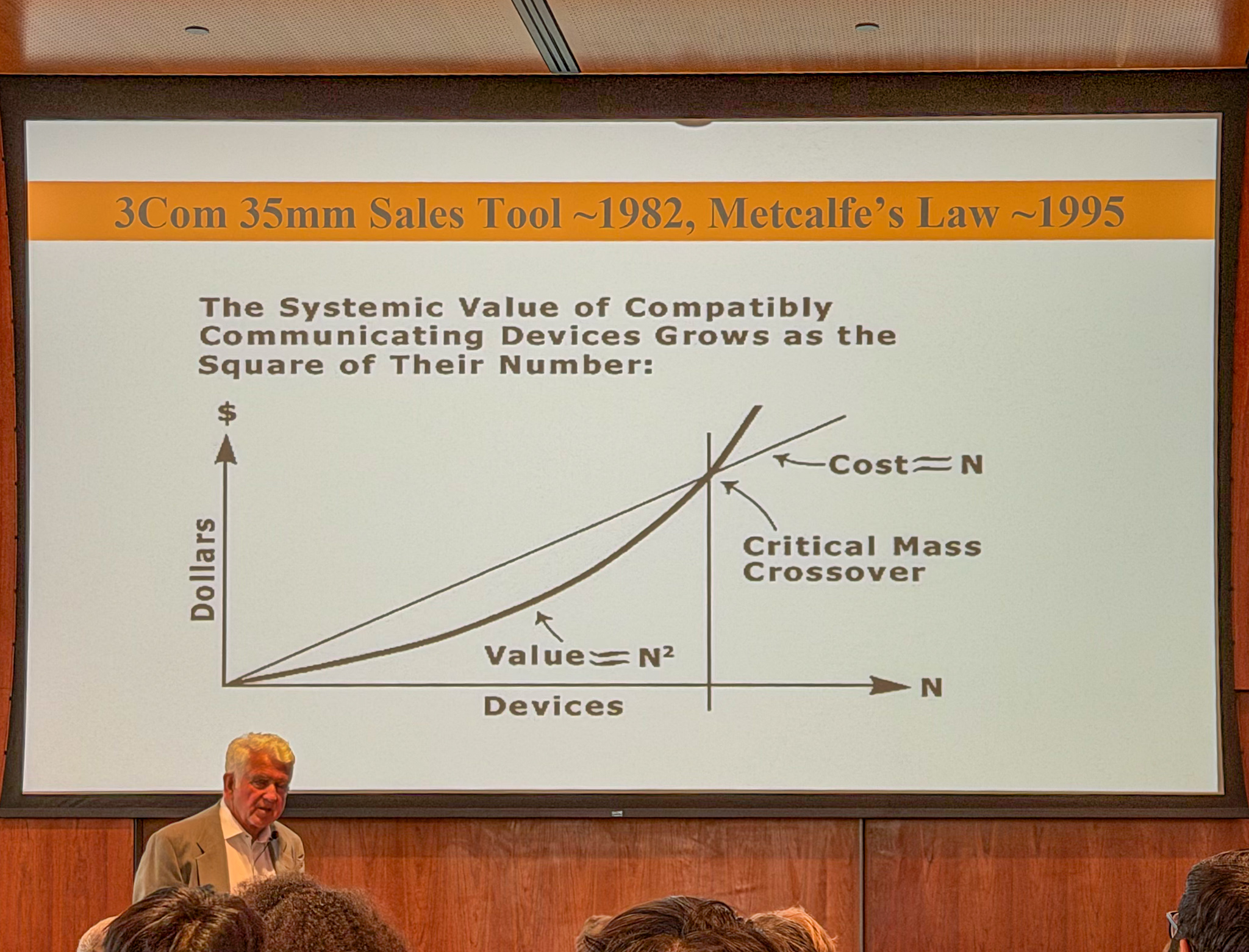
"And I gave — made six copies. That's how big my sales force was. And I gave them each a thirty-five millimeter slide and sent them off with the goal of selling more of our [00:38:30] products. And what we told our customers — they complained that their networks were too slow and too small and not very useful."
"And I needed to fix that with a slide. This is the slide that I came up with, and it's currently known as Metcalfe's Law. It basically said the remedy if your network is too small and too slow is buy more 3Com products. And they did. [00:39:00] And we went public."
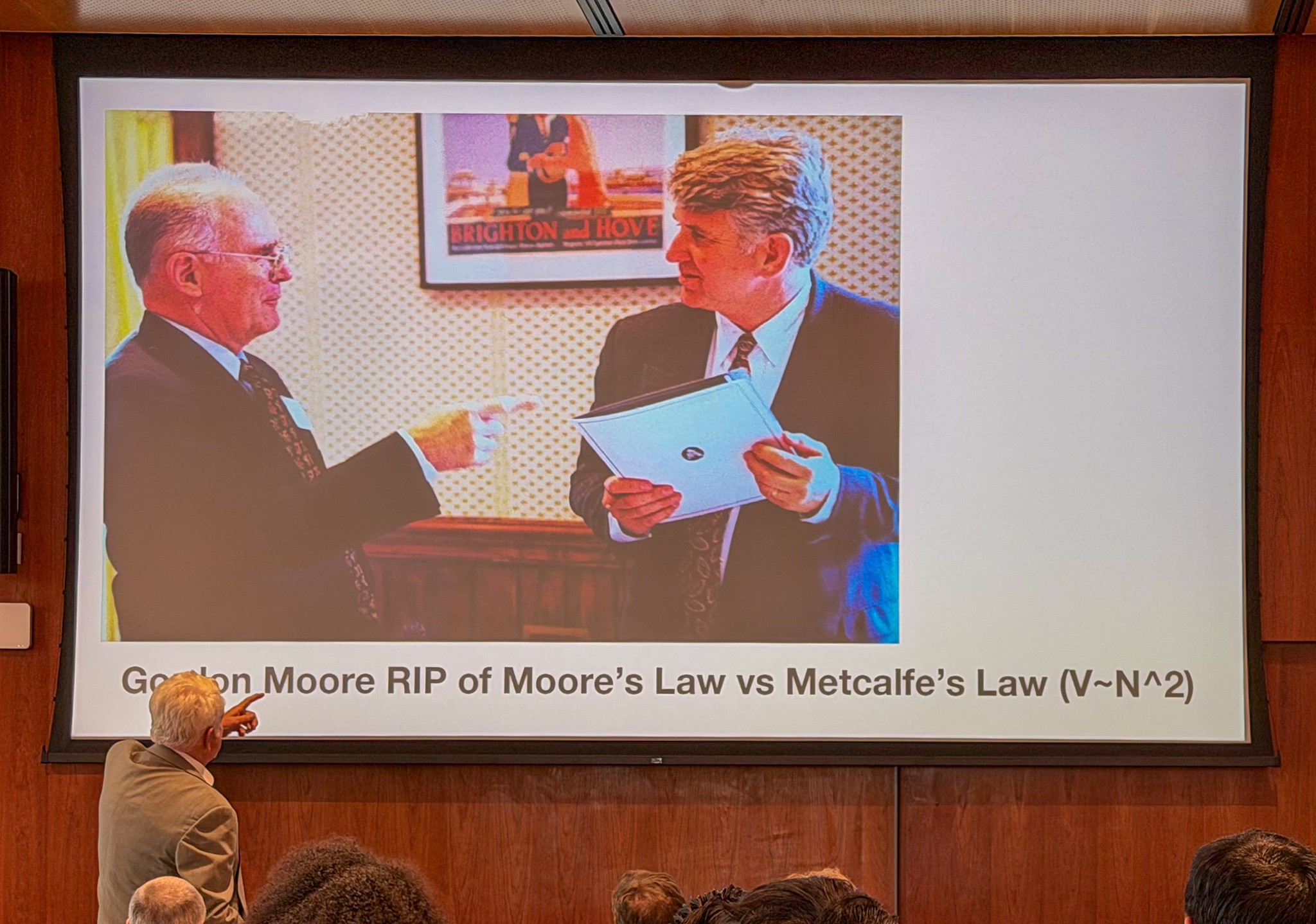
"So here's Gordon Moore, the inventor of Moore's Law, pointing out to me that my law — his law had been numerically true for twenty years by the time this — mine had never been checked."
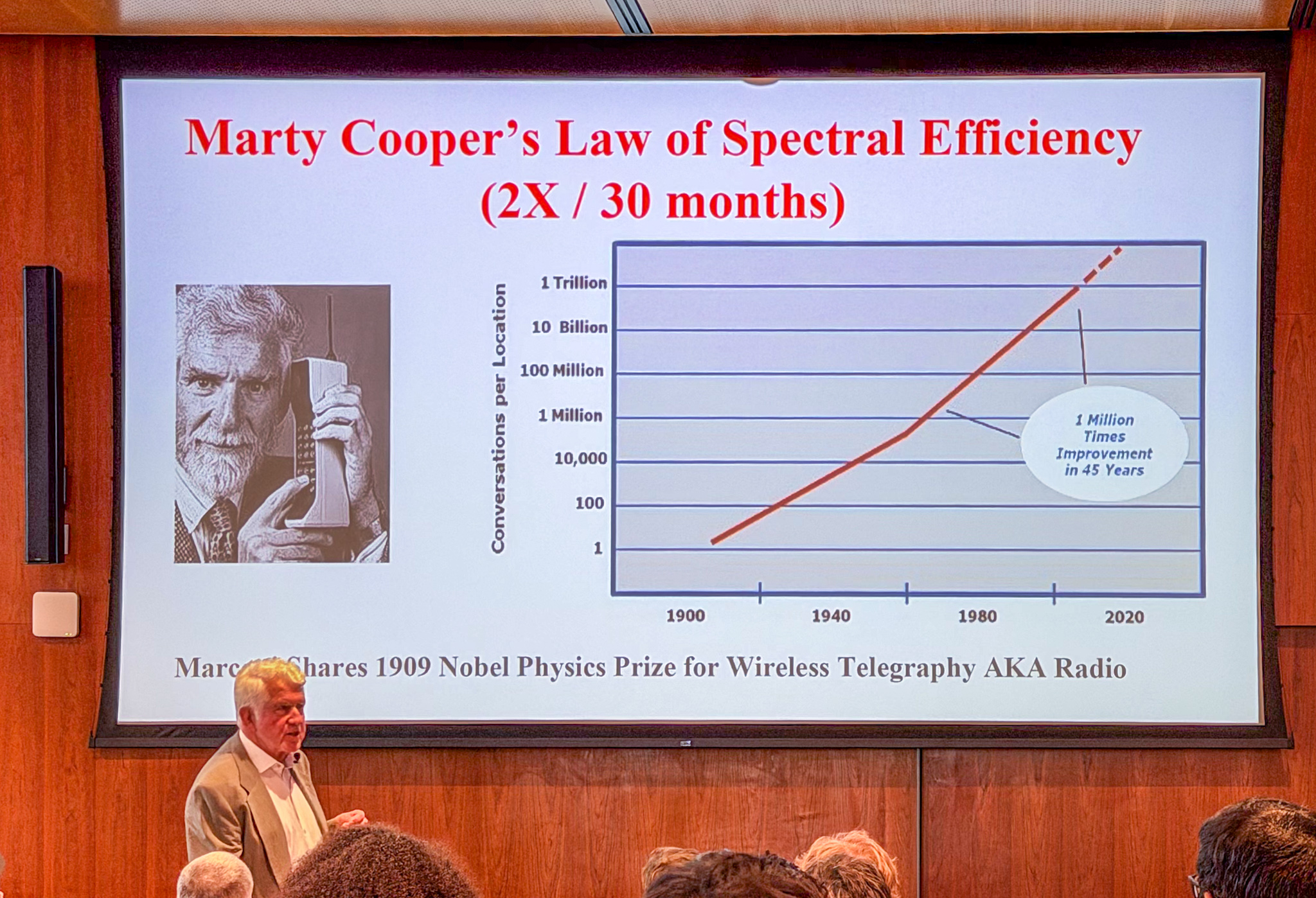
[00:39:30]"Another law that was important — Marconi invented the radio. He got a Nobel Prize for it in 1909. And Marconi was rewarded and admired by getting the radio to go further and further and further. It started in his backyard in Bologna, Italy, went across the Atlantic Ocean, longer and longer and longer. He gets the Nobel Prize, and from there on in, [00:40:00] according to Cooper's law, advances in telecom have come from having the radios go shorter and shorter distances — like a thousand meters instead of two thousand miles — and for reasons of lowering the power and also reusing the frequencies. By moving them far enough apart, you can use the same frequency in two different loops."
The Neuron Paradox
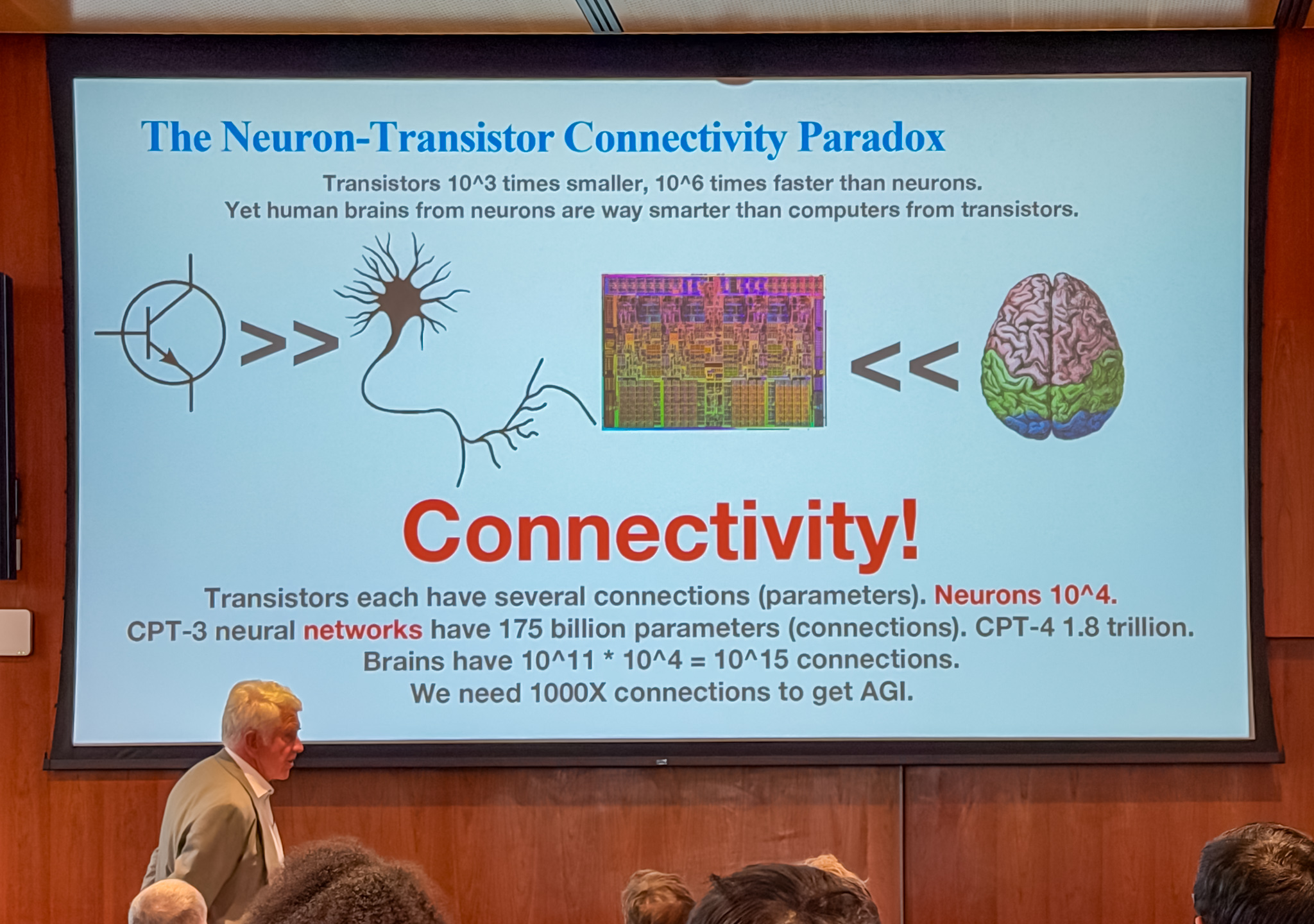
[00:41:00]"Here's a paradox. Neurons — you all have them. Billions of years old, pitifully slow and huge compared to transistors. Transistors are like a — what's it say here? Oh, there it is — transistors are a thousand times smaller and a million times faster than neurons. And yet, human brains, which are built out of pitiful neurons, are much faster and intelligent than what we can build using transistors. You all see the paradox? How can that be? You take these slower things and you make a [00:41:30] faster thing."
"And the answer is the theme of my talk, which is almost over now — connectivity. The connectivity of transistors is typically one or two or three, and the connectivity of a neuron is typically ten thousand. So the way that the neuron gets to be so powerful is by connectivity among [00:42:00] —"
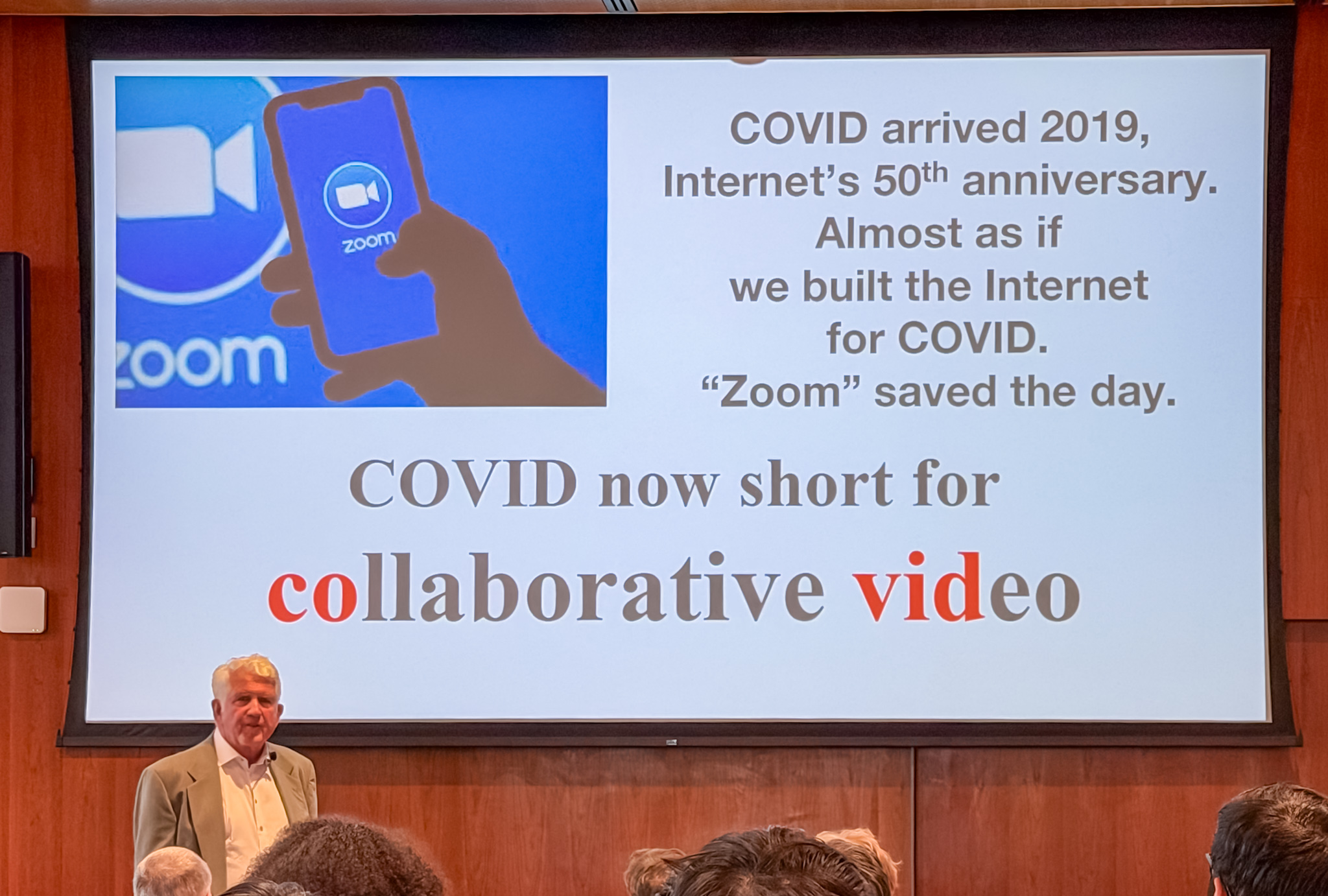
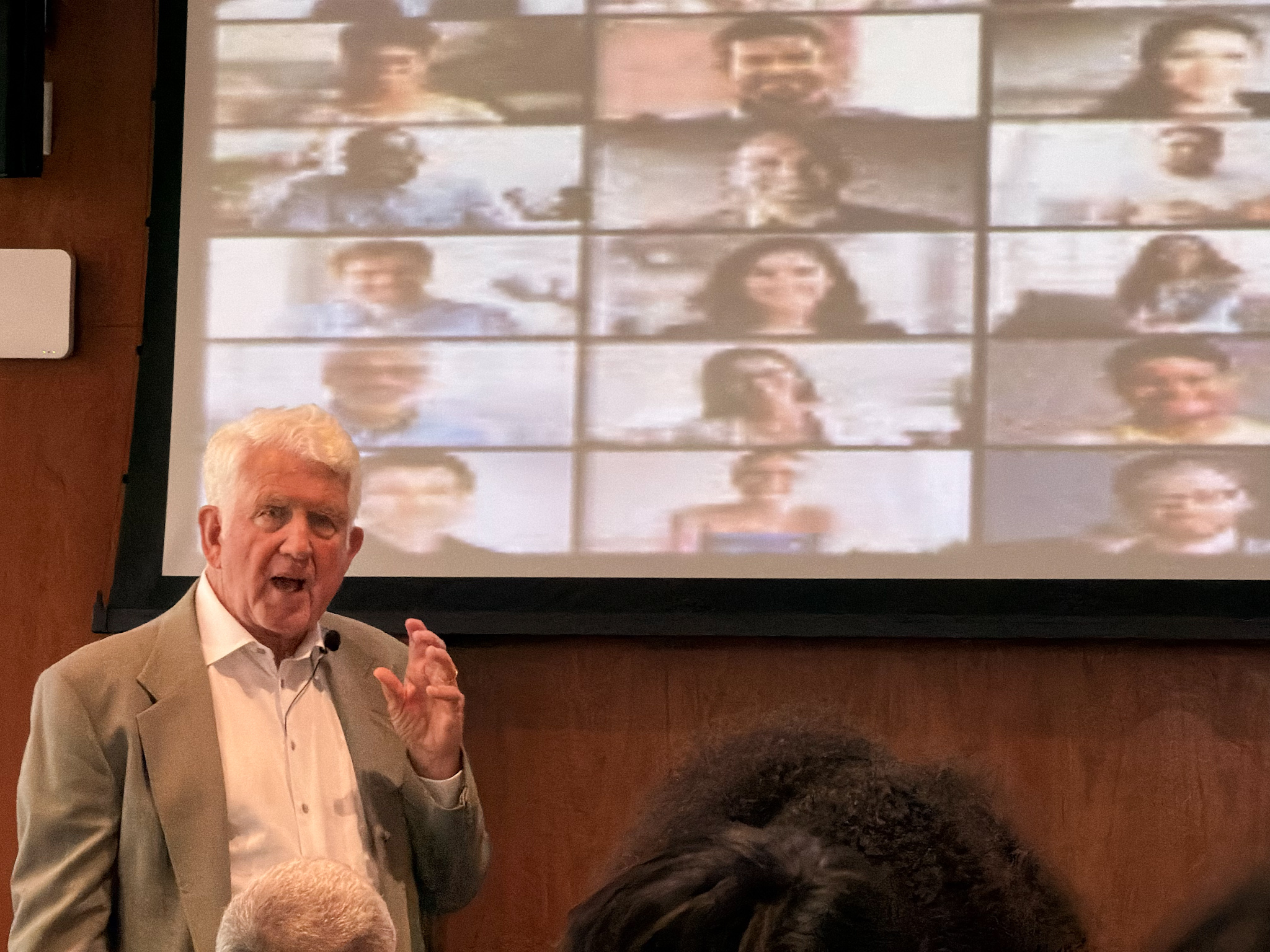
"Now COVID arrived in 2019, which was by coincidence the fiftieth anniversary of ARPANET. It was like we built the Internet for COVID. And in that vein, I'm proposing that COVID be reused as a new acronym. It be used to mean Collaborative Video, because since 2019, we've [00:42:30] all, except for this group here, learned to go to our Zooms and Zoom around the world."
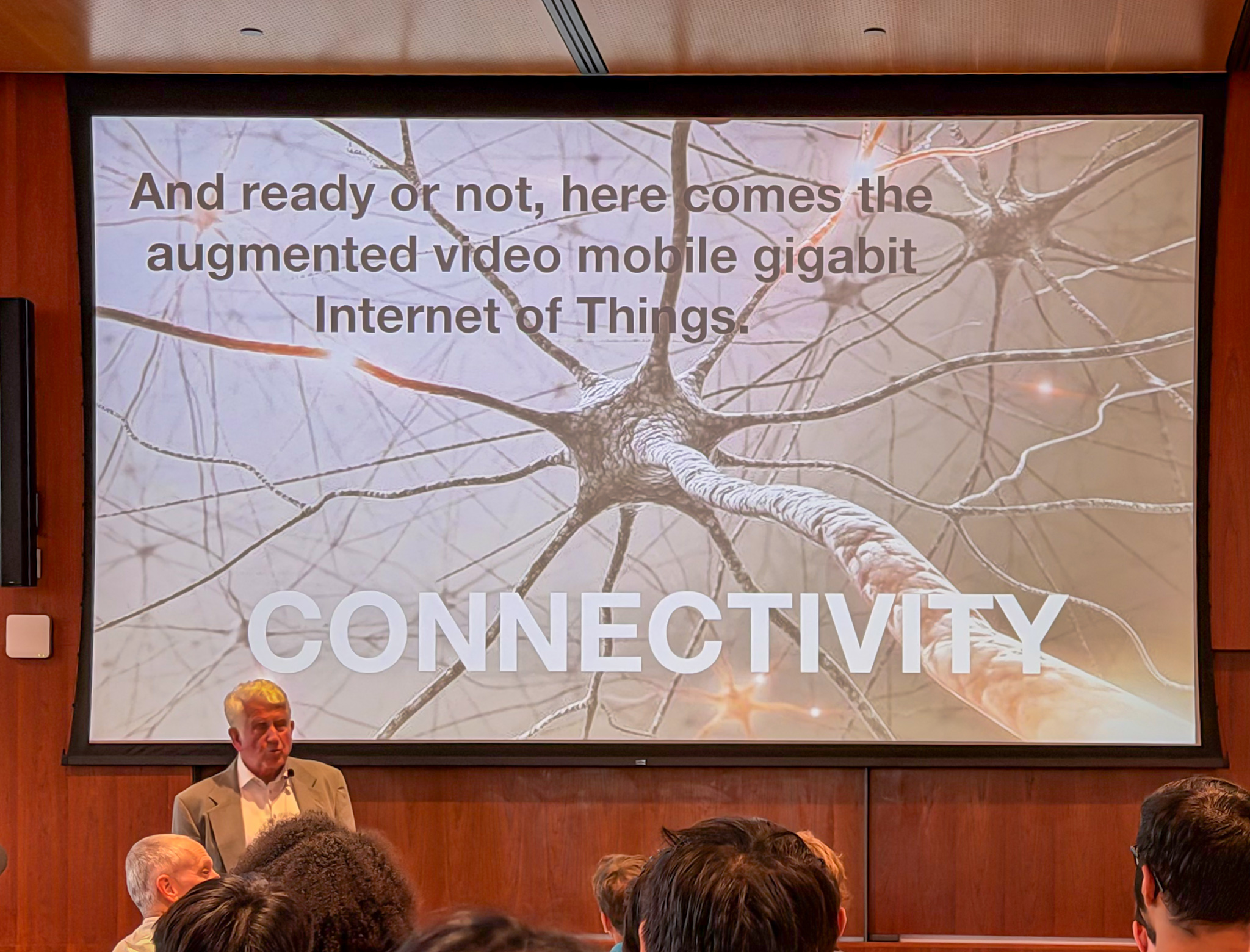
"So here's to collaborative video. And with that, I'll end my remarks. I'd love to get you all to ask me questions. We have eighty minutes — more than eighty minutes. We can go all the time if you ask. Would anyone like to ask a question? That would be appreciated. Thank you."
Questions & Answers